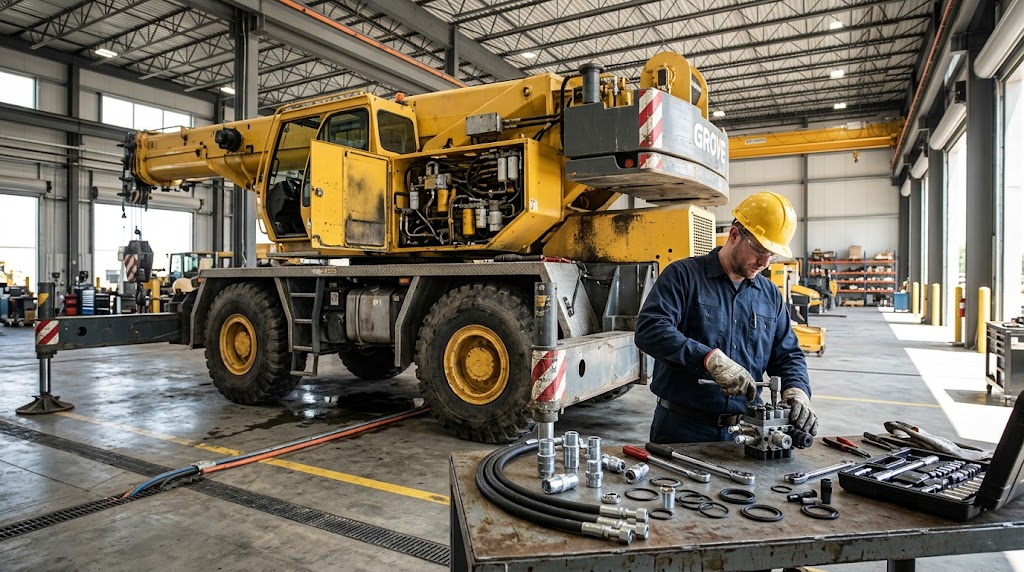
A Grove crane is built to work hard and last. The engineering behind each model reflects decades of refinement in lifting technology. Owners who buy these machines are making a long-term bet on productivity and reliability. That bet pays off only when the maintenance program behind it is sound.
Component selection sits at the heart of any maintenance program. It is not glamorous work, and it does not get much attention until something fails. But every part that enters the machine either strengthens the system or weakens it. Understanding how those small decisions accumulate is the difference between a crane that thrives and one that slowly deteriorates.
Short-Term Savings Create Long-Term Expenses
Nobody budgets for unnecessary spending. When a part fails, the instinct is to find the least expensive replacement available. The aftermarket catalog offers dozens of options, and the price differences can be dramatic. That price gap creates an illusion of value.
Cranes push components far beyond what most machinery demands. Every lift cycle loads gears, compresses seals, and strains structural connections. Crane spare parts that bypass rigorous material testing may pass a bench inspection yet fail under real operating conditions. The gap between a laboratory result and a field result is where budget components reveal their weaknesses.
A failed part rarely damages only itself. When a hydraulic line ruptures, the fluid sprays across everything nearby. When a gear tooth snaps, the fragments circulate through the housing. Each of these events triggers a chain of secondary repairs that dwarfs the original cost. The short-term saving becomes a long-term liability with surprising speed.
Matching the Original Design Is Not Optional
Every dimension, alloy, and heat treatment in a Grove crane exists because an engineer specified it. Those specifications reflect thousands of hours of testing and real-world validation. Load charts, hydraulic pressures, and structural ratings all assume the machine operates with its original components intact.
Grove parts adhere to those specifications because they are manufactured under the same quality controls as the components that first entered service. That consistency matters because it preserves the relationships between mating surfaces, load paths, and pressure circuits. Aftermarket parts, by contrast, can vary in hardness, surface finish, or dimensional tolerance in ways that are difficult to detect without specialized equipment.
Bearing assemblies offer a clear example. A bearing with marginally different ball hardness distributes load unevenly across its race. The resulting vibration accelerates wear on adjacent components, including seals and shafts. Precision-matched parts prevent this redistribution of stress entirely. The crane performs as intended because the components behave as intended.
Machine Availability Drives Revenue
A crane generates income only while it is in operation. That basic truth shapes the economics of every fleet. When a crane goes down unexpectedly, the costs compound across the entire project. Crews idle, rental equipment covers the gap, and the schedule compresses.
Components built to factory standards resist unplanned failure. They stay within their performance envelope for extended periods. That predictability allows maintenance to happen on a schedule rather than in response to a breakdown. Scheduled work is efficient; emergency work is expensive.
The management of crane spare parts inventory directly affects this equation. Owners who plan their stock avoid the rush orders and wrong-part purchases that extend downtime. A well-stocked shelf is cheaper than a day of idle labor. That inventory strategy separates reactive organizations from proactive ones.
Cranes Are Partly Digital Machines Now
Contemporary cranes contain sophisticated electronic systems that control or monitor nearly every function. The load moment indicator synthesizes data from multiple sensors in real time, giving the operator a continuously updated capacity reading. Engine management, hydraulic control, and fault detection all run through onboard processors.
Accuracy in these systems is non-negotiable. A sensor reporting values that drift from calibration produces plausible but incorrect information. The LMI will use that data without flagging an error, and the operator has no independent way to verify the reading. Grove parts include validated calibration data that matches the crane’s software, which eliminates that blind spot.
Diagnostic time is another hidden cost of substandard electronics. A module that communicates on the wrong protocol or uses a different signal range can generate fault codes with no mechanical basis. Technicians trace symptoms that lead nowhere. Correct components close that loop and restore confidence in the data.
Hydraulics Determine What a Crane Can Do
The hydraulic system converts engine power into every useful motion the crane performs. Boom lift, winch rotation, swing, and outrigger deployment all depend on pressurized fluid moving through precisely machined passages. Any disruption in that flow degrades performance across the board.
Seals are the first point of vulnerability. Inexpensive seals use compounds that may not resist the chemical properties of crane-grade hydraulic fluids. Over time, they harden, crack, and release debris into the circuit. That debris lodges in valve spools and scores cylinder walls, creating wear that spreads outward from the initial failure point.
Thermal management is equally important. Undersized pumps generate heat through internal friction, which accelerates oil breakdown. Degraded oil loses its ability to lubricate, and component wear accelerates accordingly. Grove parts are engineered to manage heat within designed limits, which protects the fluid and extends the life of every component downstream.
The Boom’s Connections Carry the Load
Every crane owner looks at the boom and sees strength. Engineers look at the same structure and see thousands of individual connections that must all hold together. Pins, bushings, wear pads, and retaining hardware each carry a share of the load. Their gradual degradation is the normal consequence of hard work.
What matters is how that degradation is managed. Replacing a factory-specification pin with a softer alternative may appear harmless at first. Over hundreds of lift cycles, the softer material wears against the bore, gradually enlarging it. That enlargement shifts load distribution within the connection, concentrating stress on one side and accelerating further wear.
Bushings, grease fittings, and propshafts require the same discipline. Hardness must match between mating surfaces, and dimensions must fall within the tolerance band the design requires. When those conditions are met, wear proceeds evenly and predictably. Inspections then reveal parts approaching replacement thresholds rather than parts that have already caused structural damage.
Service History Speaks Louder Than Sales Pitches
There comes a point in every crane’s life when it changes hands. Whether through dealer trade, private sale, or auction, the transition always involves a close look at the maintenance record. Buyers depend on that record to assess the machine’s true condition.
A log filled with traceable, specification-compliant components communicates competence. It tells the buyer that the previous owner understood the machine and invested accordingly. That confidence translates into offers that reflect the crane’s actual value rather than a discount for assumed risk.
The reverse is equally true. A maintenance history littered with unbranded parts raises questions that experienced buyers know to ask. They understand that mismatched components can mask problems, and they price the uncertainty accordingly. The parts you install today are shaping the financial outcome of a transaction years from now.
Consequences of Failure in Lifting Are Unacceptable
Cranes do work that carries inherent danger. They position heavy loads above crews, structures, and occupied spaces, often in challenging conditions. The safety systems designed to manage that risk depend on every component performing to its rated capacity without exception.
Wire ropes, load holding valves, brake assemblies, and structural connections form a continuous chain of responsibility. A single degraded link narrows the safety margin for everything above it. Standards for material testing and component certification exist to prevent that narrowing from reaching a critical threshold. They are the mechanism by which the industry manages risk.
Operators need to trust that each control input produces the intended response. That trust is built on components that have been verified through testing. Grove parts carry the documentation and certification that demonstrate this performance under realistic conditions. Anything less introduces uncertainty into an environment that cannot tolerate it.
Prepare Before You Need to React
Breakdowns test your preparation as much as they test your equipment. When a crane fails on a job site, every hour of delay costs money. The instinct under that pressure is to accept whatever is available and get the machine running quickly. That instinct leads to costly mistakes.
A baseline inventory of high-turnover items solves most of the problem. Hoses, filters, pins, seals, and hydraulic fluid should be stocked before demand arises. With the right components on hand, repairs begin immediately rather than after a shipping delay. That readiness transforms a potential multi-day outage into a same-day fix.
Supplier expertise adds another dimension to this preparation. Someone familiar with the equipment line can verify part numbers, identify current supersessions, and flag compatibility concerns before an order ships. That knowledge prevents the missteps that come from ordering under time pressure. Over time, that relationship becomes one of the most valuable tools in your maintenance program.
The Decades-Long Perspective Pays
Maintaining a crane is not about any single decision. It is about the cumulative effect of hundreds of decisions made over many years. The pressure to reduce costs at each decision point is understandable. But the aggregate outcome of that pressure rarely favors the owner.
Components engineered to original specifications prevent the secondary failures that cheaper alternatives invite. They reduce downtime, protect operators, and extend the intervals between major repairs. They also preserve the equity embedded in the machine for the day it eventually changes hands.
The next time you specify a component for your equipment, consider the crane’s complete service life. Choose parts that fit precisely, endure the designed duty cycle, and perform within published safety margins. That perspective keeps cranes productive for decades rather than years.