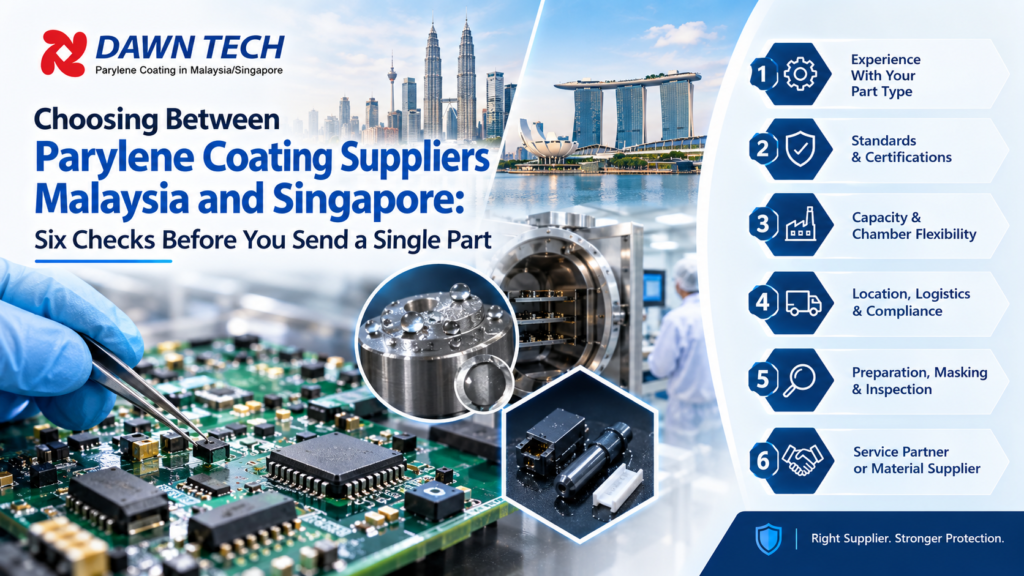
Electronics, medical devices, and sensor makers across Southeast Asia increasingly rely on parylene to protect delicate parts from moisture, chemicals, and corrosion. The region has capable options on both sides of the causeway, but they are not interchangeable. Choosing between parylene coating suppliers Malaysia and Singapore comes down to fit, not reputation alone. A supplier that suits a high-volume PCB line may be wrong for a low-volume implantable component. Before you ship a single part, it helps to know what to verify. This article covers six practical checks, explains why each one matters, and shows how to compare suppliers on equal terms so your decision rests on evidence rather than a polished quote.
Check One: Confirm Their Experience With Your Part Type
Parylene is a vapor-deposited polymer, first developed commercially in the 1960s, and it behaves very differently from liquid conformal coatings. A supplier who mostly coats simple circuit boards may struggle with catheter tubing, magnets, or complex connectors.
Ask for examples of similar parts they have coated. Specifics matter here. Which variant did they use, what thickness did they target, and how did they handle masking? A confident supplier answers without hesitation.
Check Two: Ask What Standards Guide Their Work
Parylene is used in regulated industries, so documentation is not optional. Depending on your sector, you may need to see how a supplier aligns with quality systems such as ISO 9001, or with medical device requirements such as ISO 13485.
Be careful with wording. A supplier that “follows” a standard is not the same as one that holds a certificate. Ask which one applies, and request proof when certification matters to your customers.
Check Three: Look at Capacity and Chamber Flexibility
Chamber size affects what you can coat in one batch, and batch planning affects cost. A large chamber suits many small parts. A smaller one may give better control for fragile or specialized items.
Raise these points early:
- Maximum part dimensions the chamber can handle
- Typical batch size and turnaround time
- Ability to coat multiple parylene types
- How they manage rush orders without cutting corners
Turnaround deserves extra thought. Quoted lead times often exclude cleaning, masking and inspection, which can add days.
Check Four: Weigh Location, Logistics and Compliance Together
Distance is not only about shipping cost. Cross-border movement of electronics can involve customs paperwork, handling risk and extra waiting time. For a team building in Johor, a nearby site may cut transit to hours. For a company based in Singapore with its assembly in Malaysia, the logistics may favor a different arrangement entirely.
Compare more than the price per part. Count the full cycle: packaging, courier, customs clearance, coating, inspection and return. A cheaper quote can lose its advantage once delays are included.
Check Five: Review How They Prepare, Mask and Inspect
Most coating failures begin before deposition. Cleaning, adhesion preparation and masking decide whether the film bonds well and whether connectors stay usable.
A solid supplier should explain how they verify cleanliness and how they seal masked areas. They should also describe their inspection method after coating. Many use visual checks under magnification and, where needed, thickness measurement on witness coupons processed alongside your parts.
Here is a simple example. A team once sent boards with flux residue under low-profile components. A careful provider flagged the issue during intake and requested recleaning, which saved the batch. A less careful one might have coated over it and let the problem surface in the field.
Check Six: Decide Whether You Need a Service Partner or a Source of Material
Terms get mixed up in this market. Some companies coat parts for others, some supply dimer and equipment, and some do both. If you search for a parylene coating manufacturer, you may find results that mean very different things.
Clarify what you actually need. If you want finished, coated parts, you need a service provider with strong process control. If you plan to bring coating in-house, you need an equipment and materials partner. DawnTech is an example of a company in the region that works in the coating space, though any shortlisted firm should be judged on the same checklist above.
Questions to Ask Every Shortlisted Company
- Can you share a sample report or inspection record?
- How do you handle nonconforming parts?
- What happens if a coated part fails in testing?
- Who is my direct technical contact?
Clear, quick replies to these questions say a lot about how a relationship will go.
Running a Fair Comparison between parylene coating suppliers Malaysia and Singapore
Once you have answers, put them side by side. Score each supplier on experience, certification, capacity, logistics, process control and support. Weight the categories by what matters most to your product. A medical device team may prioritize documentation, while a consumer electronics team may care more about speed.
If possible, run a small pilot with two suppliers using identical sample parts. Compare adhesion, coverage in tight areas and how clean the masked boundaries look. Real results beat promises every time.
Making the Final Call
No single answer fits every buyer. The best choice among parylene coating suppliers Malaysia and Singapore is the one that matches your part geometry, quality requirements, schedule and risk tolerance. Work through the six checks, ask for evidence instead of assurances, and trust the supplier that explains limits as openly as strengths. A short pilot costs little compared with a failed production run. Take your time now, and the coating will do its quiet work for years after the parts leave your hands.