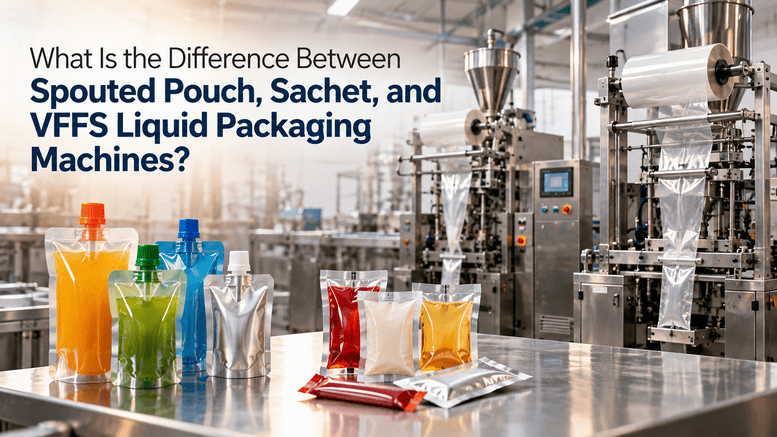
Comparison of three liquid packaging formats: spouted pouches, sachets, and VFFS formed bags.
A liquid packaging project can look straightforward until the production team has to choose the actual package format. A sauce may work in a small sachet for single-use distribution, while the same product could also be sold in a larger spouted pouch. A beverage or liquid product may instead be better suited to bags made directly from rollstock.
This is where an automatic liquid packaging machine becomes more than a piece of filling equipment. The machine has to match the liquid, package design, filling volume, sealing method, production rate, film or pouch material, and downstream requirements.
Spouted pouch, sachet, and VFFS systems can all handle liquid applications, but they do not produce the same package or operate in the same way. Some use preformed pouches, while others form the package from rollstock. Some are designed around capped dispensing, while others focus on compact sealed portions and high lane counts.
This guide breaks down the differences between the three systems, explains where each format makes sense, and provides practical criteria for selecting equipment without judging a machine by speed alone.
The right liquid packaging machine is the one that matches the product, package, production pattern, and handling requirements as a complete system.
Key Considerations
The supplied Unified Flex information identifies liquid packaging options across several formats, including sachets, VFFS, stand-up pouches, popsicle packaging, and spouted pouch filling and capping. Its stated ranges include 40 to 1,000 bags per minute for liquid sachet and VFFS applications, and 12 to 80 pouches per minute for spouted pouch filling and capping. These are manufacturer-supplied ranges, not universal production guarantees.
- Sachet format: Intended for compact 3-side or 4-side sealed packages, with liquid applications supported through suitable filling systems.
- Spouted pouch format: Uses preformed pouches and combines filling with cap placement and tightening.
- VFFS format: Forms bags from rollstock before filling and sealing them.
- Filling method matters: Piston fillers are identified in the supplied information for liquids and gels in multilane sachet applications.
- Package size matters: Spouted pouch equipment in the supplied information covers fill volumes from tens of milliliters up to 2 liters, depending on model.
What Makes Spouted Pouch, Sachet, and VFFS Machines Different?
The simplest distinction is the way each system creates and finishes the package. A spouted pouch system works with a preformed pouch that already has the basic pouch structure, then fills it and installs or tightens its closure. A sachet machine creates small sealed portions, generally using a 3-side or 4-side seal format. A VFFS machine starts with rollstock and forms the bag as part of the packaging cycle.
That difference affects almost everything downstream. The pouch format determines how consumers open, pour, squeeze, store, and reuse the product. It also influences the type of filling equipment, sealing arrangement, film handling, cap or closure requirements, changeover process, and line integration.
For example, a liquid soap intended for controlled dispensing may benefit from a spouted pouch with a cap. A sauce intended for single-use foodservice portions may make more sense in a sachet. A high-volume liquid product sold in a simple flexible bag may suit a VFFS configuration.
The important point is that these machines should not be treated as interchangeable versions of the same equipment. They solve different packaging problems.
What Are the Main Characteristics of Each Liquid Packaging Format?
The three systems can all support liquid products, but their operating priorities are different. Looking at the package first often makes the machine decision much clearer.
- Spouted pouches use preformed bags: The pouch arrives at the machine in a prepared format, after which the equipment handles pouch positioning, filling, spout and cap operations, and discharge. The supplied spouted pouch systems use rotary indexing and can include automatic cap placement and torque control.
- Sachets focus on compact portions: Sachet equipment produces 3-side or 4-side sealed packages and can be configured for multiple lanes. The supplied information states that sachet machines are available from 1 to 20 packaging lanes.
- VFFS forms the bag during production: Rollstock passes through the machine, where the package is formed, filled, sealed, and cut as part of the production process.
- Liquid filling technology varies: The filler has to suit the liquid. The supplied information identifies piston fillers for liquid and gel applications in multilane sachet systems.
- Package handling differs: A preformed spouted pouch requires pouch loading and positioning, while VFFS depends on controlled film movement and forming.
- Consumer use is different: A capped spouted pouch is designed around pouring or dispensing, while a sachet generally supports single-use opening and a VFFS bag may use a simple tear or seal format.
- Production requirements influence the choice: High lane counts can support large sachet output, while spouted pouch systems prioritize the added operations required for filling and capping.
The format therefore needs to be selected before the machine specification is finalized, not after.
How Does a Spouted Pouch Filling and Capping Machine Work?
A spouted pouch system is built around a different workflow from a rollstock-based VFFS machine. Instead of forming the entire pouch from a continuous film web, the system handles preformed pouches and adds the filling and closure operations required for the finished package.
Pouch Loading and Positioning
The pouch has to arrive in the correct position before filling. The supplied MS-1 system uses a six-station rotary arrangement covering pouch loading, air inflation, filling, cap placement, cap tightening, and pouch exit.
That sequence matters because each station performs a defined task. Accurate positioning helps keep the pouch stable while the product is introduced and the closure is installed.
Liquid Filling
The filling method depends on the product. The supplied information identifies integrated piston or pump options depending on the product, while larger configurations are described for industrial liquid and gel applications.
Viscosity is particularly important here. A free-flowing beverage does not behave like a thick sauce or lotion. Filling equipment therefore needs to be evaluated using the actual product rather than assuming that one filling method will work equally well for every liquid.
Cap Placement and Torque
After filling, the pouch can move to cap placement and tightening. Torque control is important because a closure needs enough force to secure the package without creating an unsuitable closure condition.
The supplied MS-1 configuration includes an independent capping head with torque-out capability and pouch detection through a “No Pouch, No Fill” function.
Pouch Discharge
Once filled and capped, the pouch exits the rotary system for collection or further handling. A takeaway conveyor can also be included as an optional feature on the referenced system.
This makes spouted pouch packaging particularly useful when dispensing convenience and a resealable closure are important parts of the package design.
How Do Sachet and VFFS Liquid Machines Handle the Packaging Process?
Both sachet and VFFS systems can form flexible packages from film, but their package structures and production arrangements differ. The choice often comes down to portion size, bag shape, lane configuration, film handling, and the desired finished package.
Sachet Packaging
Sachet systems are designed around small sealed portions and can be configured for multiple lanes.
- They can produce 3-side and 4-side seal sachets.
- Liquid and gel products can be handled with appropriate filling equipment.
- Multilane configurations allow several sachets to be produced within the machine cycle.
- The supplied MSB range includes configurations rated up to 500, 600, and 1,000 sachets per minute, depending on model.
VFFS Liquid Packaging
VFFS systems form the package from rollstock and coordinate film movement, filling, sealing, and cutting.
- Rollstock provides the packaging material for the forming process.
- The final bag dimensions depend on machine configuration and film width.
- Different bag styles can be supported, including 3-side, 4-side, pillow, and spouted formats in the supplied machine information.
- Liquid applications require filling equipment that can deliver the required volume without excessive splashing or product contamination around the seal.
The main difference is therefore not simply speed. Sachet equipment is built around compact multi-lane portions, while VFFS provides a broader rollstock-based bag-forming approach.
When Is Each Machine a Better Fit for Liquid Packaging?
Machine selection becomes easier when the production requirement is translated into the finished package the customer will actually receive. A system intended for single-use condiments has a very different job from one producing a resealable pouch of detergent or a larger liquid product.
A sachet system is generally appropriate when the package needs to be compact, portioned, and sealed without a separate cap. The supplied information lists sauces, creams, liquid supplements, gels, lotions, and similar products among sachet applications.
A spouted pouch system becomes more relevant when dispensing and closure are important. The supplied equipment covers spouted pouches for liquids and semi-liquids such as dressings, sauces, juices, soaps, shampoos, and detergents. It also supports pouch volumes that vary by model, with documented configurations extending up to 2 liters.
VFFS is useful when the operation needs to form flexible bags directly from rollstock. The supplied information lists VFFS liquid applications from 40 to 1,000 bags per minute, although actual output depends on the machine, filling system, package dimensions, material, product, and operating conditions.
For an industrial packaging machine, the decision should therefore begin with the package format and production requirement, then move into filling technology, film or pouch material, controls, utilities, changeover, maintenance, and line integration.
How Do Product Characteristics Affect the Machine Choice?
The liquid itself can be as important as the package. Two products may both be described as liquids while behaving very differently inside a filling system.
Viscosity and Flow
Low-viscosity liquids can move differently from thick sauces, creams, lotions, or gels. The filling system needs to accommodate the actual flow behavior.
A product that pours freely may require different pump or piston settings from a thick product that moves slowly. Filling trials are therefore useful before final machine specifications are approved.
Foaming and Air Entrapment
Some liquids foam when pumped or agitated. Excess foam can affect fill consistency and create problems around the sealing area.
The filling sequence, nozzle design, pump selection, and operating speed should be evaluated with the real product rather than relying on a generic liquid classification.
Temperature
Some products may be filled at ambient conditions, while others have specific temperature requirements. Temperature can affect viscosity, flow behavior, sealing conditions, and product handling.
The machine specification should therefore state the actual product temperature range expected during production.
Product Sensitivity
Food, beverages, cosmetics, household chemicals, and other liquids can have different hygiene, material compatibility, and cleaning requirements.
Product contact components need to be suitable for the application, and cleaning procedures should be established according to the product and applicable requirements.
How Do Package Design and Film Choice Affect Machine Performance?
The package material is not just an outer layer. It becomes part of the machine process, especially in VFFS and sachet applications. Film has to move correctly, form consistently, and create a reliable seal under the operating conditions.
A VFFS line depends heavily on controlled film movement. If the film tracks poorly, bag dimensions and seal positions can shift. Printed film also needs accurate registration when graphics, codes, or other package information must appear in specific locations.
Sachet machines have similar concerns, especially when several lanes operate from one web. Film alignment and sealing conditions need to remain stable across the working width.
Spouted pouches introduce a different material consideration because the pouch is already formed before it reaches the filler. The pouch, spout, cap, and filling equipment have to work as a compatible set.
When comparing systems, evaluate:
- Film or pouch structure and thickness
- Heat-sealing characteristics
- Pouch dimensions
- Spout and cap configuration
- Required seal width
- Product contact compatibility
- Print registration requirements
- Tear or opening requirements
- Storage and transport conditions
- Cleaning and handling requirements
A machine that works well with one packaging structure should not automatically be assumed to work with another.
What Should Be Checked Before Installing a Liquid Packaging Machine?
A packaging machine should be evaluated as part of the complete production line. A machine can perform well on its own and still create problems if the product supply, packaging material, utilities, or downstream equipment are not coordinated.
Test With the Actual Liquid
Machine trials should use the product that will actually be packaged whenever possible. Testing only with water may not reveal issues caused by viscosity, foam, particulates, temperature, or product behavior.
Record fill volume, package appearance, seal condition, leakage, and machine adjustments during the trial.
Test the Actual Packaging Material
The film or preformed pouch should also be part of the evaluation. Check how the material behaves during forming, filling, sealing, pouch transfer, cap installation, and discharge.
Review Changeovers
If several products or package sizes will run on the same machine, changeover requirements deserve attention before purchase.
Check:
- Tooling requirements
- Recipe storage
- Cleaning access
- Operator adjustments
- Change parts
- Product-contact cleaning
- Verification after setup
Plan Maintenance and Safety
Operators need safe access to areas requiring cleaning, inspection, or routine maintenance. Guards, electrical systems, moving components, pneumatic systems, and lockout procedures should be addressed according to the machine and applicable safety requirements.
Maintenance planning should also cover wear parts, sensors, sealing components, pumps, fillers, and other parts that can affect production.
A packaging line should be tested as a complete process, because the weakest interface can determine the performance of the whole system.
What Should You Compare Before Selecting a Liquid Packaging System?
The best machine comparison is based on measurable production requirements rather than a single advertised speed. Start by defining the product, package, target output, operating environment, and future requirements.
- Define the liquid: Record viscosity, temperature, foaming behavior, particulates, and other properties that affect filling.
- Define the package: Decide whether the finished product needs a sachet, a capped spouted pouch, or a bag formed from rollstock.
- Set the fill range: Establish minimum and maximum fill volumes and the acceptable variation.
- Set the production requirement: Specify normal target output rather than relying only on peak machine capacity.
- Test packaging materials: Run the actual film or preformed pouch through the proposed process.
- Evaluate changeovers: Consider how often products, pouch sizes, films, or recipes will change.
- Review the complete line: Account for conveyors, fillers, pumps, coding, inspection, collection, and other connected equipment.
A supplier evaluation should also include machine documentation, installation requirements, operator training, spare-parts availability, service arrangements, maintenance procedures, warranty terms, and testing with the actual product.
The supplied Unified Flex information also describes turnkey liquid packaging support involving fillers, conveyors, mezzanines, preformed pouches, rollstock, and complete bagging systems. That type of integration can matter when a project requires more than the core filling machine.
Practical Takeaway
Do not choose between spouted pouch, sachet, and VFFS equipment until the finished package and production conditions have been defined. The machine should be selected around the actual liquid and the package it needs to produce.
Packaging Machine Industry Snapshot
The supplied Unified Flex information shows how broad the liquid packaging category can be. Its liquid and beverage portfolio includes sachet machines, VFFS machines, stand-up pouch systems, popsicle packaging equipment, and spouted pouch filling and capping systems.
The stated machine ranges also show why output alone is not enough for comparison. Sachet and VFFS systems are listed at ranges reaching up to 1,000 bags or sachets per minute, while spouted pouch systems are listed at up to 80 pouches per minute depending on configuration. These figures describe different packaging processes and should not be treated as directly equivalent measures of productivity.
Choosing the Right Format for a Multi-Product Liquid Line: An Illustrative Case
Consider a hypothetical manufacturer producing three liquid product categories: single-use sauce portions, resealable personal care products, and larger liquid products packed in flexible bags.
This is an illustrative scenario, not a documented customer case.
The Situation
The company wants one packaging strategy for several product families but notices that each product has a different package requirement.
The sauce is distributed in small portions. The personal care products need convenient dispensing and closure. The larger liquid products need flexible bags without the additional closure hardware associated with a spouted pouch.
The Challenge
Using one machine format for every product would create compromises.
The sachet format makes sense for small portions but does not provide the same dispensing experience as a capped pouch. A spouted pouch provides convenient dispensing but introduces pouch handling, spout, and cap operations. A VFFS system can form bags directly from rollstock but may not provide the same resealable experience.
The Approach
The manufacturer evaluates each product separately:
- The sauce is assigned to a suitable sachet configuration using an appropriate liquid filler.
- The personal care products are evaluated with a spouted pouch filling and capping system.
- The larger flexible bags are evaluated using a VFFS configuration with a liquid filling system.
- Each package is tested with its actual material and product.
- Output, fill consistency, sealing, leakage, changeover, cleaning, and operator requirements are recorded.
The Outcome
Because this is an illustrative case, no measured production improvement or financial result is claimed.
The practical outcome is a clearer equipment specification. Instead of asking which machine is “best” for every product, the manufacturer identifies which packaging format solves each product’s actual requirements.
The main lesson is straightforward: three liquid packaging technologies can coexist in the same production strategy because they serve different packaging objectives.
Practical Lessons
- Choose the package before choosing the machine.
- Test liquid behavior with the actual filling equipment.
- Treat filling, sealing, and closure operations as connected processes.
- Compare sustainable production output rather than peak speed alone.
- Include cleaning, maintenance, changeover, and safety in the original specification.
- Evaluate future products and package sizes before finalizing the machine configuration.
Spouted Pouch vs Sachet vs VFFS: Decision-Making Comparison
The following table summarizes the main differences so production teams can quickly narrow down which technology deserves further testing.
|
Criterion |
Spouted Pouch | Sachet |
VFFS Liquid |
| Basic package | Preformed pouch with spout and closure | Small sealed sachet | Bag formed from rollstock |
| Typical use case | Products requiring dispensing and closure | Single-use or portioned liquids | Flexible bags produced directly from film |
| Filling process | Fill into positioned pouch | Fill into formed sachet | Fill into bag during forming cycle |
| Closure | Spout and cap | Heat-sealed package, depending on format | Heat-sealed bag, depending on format |
| Production approach | Rotary pouch handling | Single or multilane production | Rollstock forming and sealing |
| Product examples | Sauces, juices, shampoos, detergents | Sauces, creams, liquid supplements, oils | Liquids and gels where the selected VFFS configuration is suitable |
| Main selection factor | Dispensing, closure, pouch size | Portion size and lane/output requirements | Film, bag format, filling system, and output |
| Key evaluation areas | Pouch handling, filling, cap placement, torque | Lane configuration, filler, film, seals | Film movement, forming, filling, sealing |
| Best starting question | Does the product need a resealable dispensing pouch? | Does the product need a compact portion pack? | Should the machine form the bag directly from rollstock? |
Frequently Asked Questions
Is a spouted pouch machine the same as a VFFS machine?
No. A spouted pouch filler and capper generally handles preformed pouches and performs filling and closure operations, while a VFFS machine forms a bag from rollstock before filling and sealing it.
Can sachet machines package thick liquids?
They can be configured for liquid and gel applications, but suitability depends on the actual product characteristics and filling system. The supplied information identifies piston fillers for liquids and gels in multilane sachet applications.
Which format is better for resealable liquid products?
A spouted pouch is generally the more relevant format when controlled dispensing and resealing are part of the package requirement. The actual pouch, spout, cap, product, and filling process should still be tested together.
Can VFFS machines package liquids?
Yes. The supplied Unified Flex information lists VFFS machines for liquid and gel applications, with liquid packaging ranges stated from 40 to 1,000 bags per minute depending on configuration. Actual production output depends on the complete machine setup and operating conditions.
What should be tested before buying liquid packaging equipment?
Test the actual liquid and packaging material whenever possible. Evaluate fill volume, consistency, sealing, leakage, package appearance, changeover, cleaning, machine adjustments, operator requirements, and integration with upstream and downstream equipment.
Final Thoughts
Spouted pouch, sachet, and VFFS liquid packaging machines solve different production problems. A spouted pouch system is built around preformed pouches, filling, and closure. Sachet equipment focuses on compact sealed portions and can use multiple lanes for larger production requirements. VFFS equipment forms flexible bags from rollstock and combines forming, filling, sealing, and cutting within the packaging process.
The right choice depends on more than output. Product viscosity, foaming, fill volume, package design, film or pouch construction, changeover frequency, cleaning, maintenance, safety, utilities, and downstream integration all matter.
For manufacturers comparing these technologies, the most useful next step is to define the product and finished package first, then test the proposed system using the actual liquid and packaging material. That approach creates a more realistic basis for machine selection and helps prevent a costly mismatch between equipment and production needs.
Good packaging equipment does not simply fill a package. It fits the product, package, process, and production plan together.