There is one thing that can undermine the potential good look of hats. A logo may look polished on the right headwear, and excellent artwork can look untidy on the wrong surface. Different types of embroidery hat styles work well with various decoration techniques.
The right choice is determined by fabric, panel shape, artwork, production, and use. The blank must be chosen in conjunction with the decoration. Artwork must also be appropriate for the surface to be used. When individuals are aware of these differences, they can avoid having unsupported logos, unreadable information, and disappointing product results.
What Types of Hat Styles Work Best for Stitching?
- Structured baseball hats are usually the best place to begin embroidery branding. They are engineered to have reinforced front panels that create a stable platform and hold stitches in place.
- Another great choice is trucker caps. They feature a structured front that allows for bold designs. Five-panel versions also provide a wide unbroken surface.
- Snapbacks are also a great option due to their rigid front panels that allow for a larger logo. They are ideal for streetwear and event swag.
For Buyers
- Use a rigid front for letters or small details.
- Please review the ornamentation space before approvals are given.
- For high-volume orders, ask for a stitched sample.
For Manufacturers
- Utilise appropriate stabilisation and cap framing.
- Check stitch density and dimensions.
- Assess the placement of tests on seams.
When is It a Good Idea to Buy Printed Finish Hats?
Printed hats are an appropriate option when details in the visual are more important than texture. The printed image might include features, such as a colourful festival graphic, illustrated mark, or detailed artwork.
It is also good for promotional runs that require wider distribution. The flat finish gives a different look. If you wish to design your own cap UK, you need to go further than the logo. Consider material, decoration area, colour contrast, and audience. A design tailored to fit the surface tends to give a more professional appearance.
What Sort of Different Look Can Be Made with the Softer Styles?
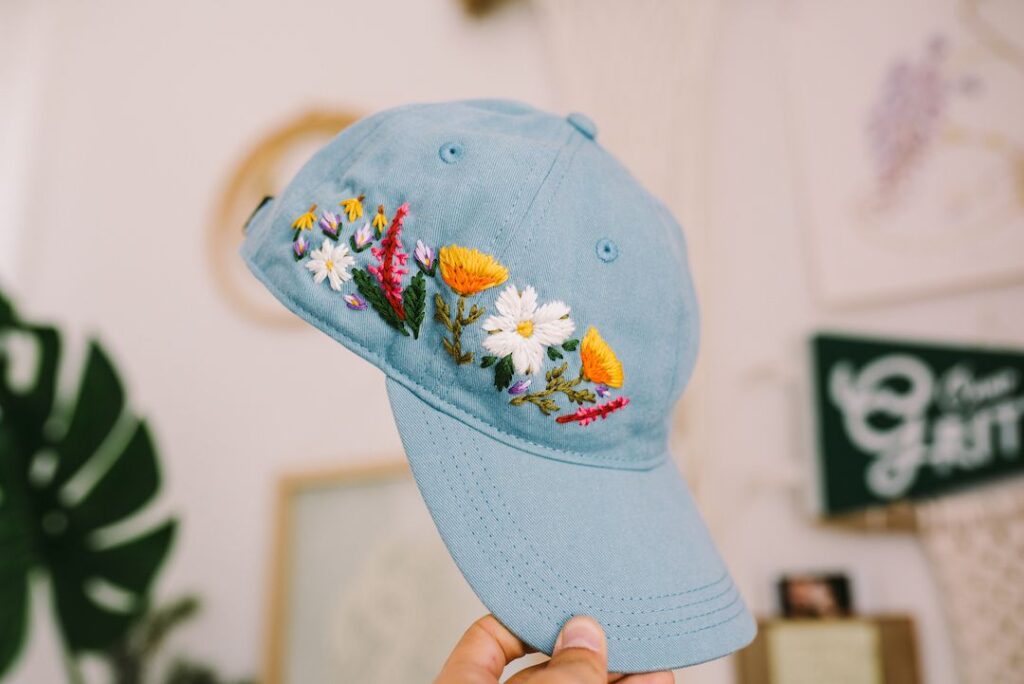
Dad hats are intentionally casual and laid-back. They are perfect for lifestyle brands, casual wear, and minimalist designs. Flexible fronts will react more during the stitching, so dense artwork may pucker or make the artwork look heavy.
Usually, it is better to use small icons, initials, or simple wordmarks rather than detailed illustrations. Manufacturers may require more powerful stabilisation and setting adjustments. Do not force large logos onto small panels. You can enhance the appearance by making small text easier to read.
Why Beanies Are Considered Ideal for Branding in Winters?
Knitted fabric stretches, and there is a visible texture in this kind of material, which is why beanies demand a different approach. The folded part of cuffed beanies also provides additional support for the decoration area, which makes them the most practical option. Simple logos and short words are clearer. Stretchy designs and patterns can become lost in the knit or can be too tight.
Useful Production Sequence
- Choose a cuffed and stable knit.
- Simplify illustrations as needed.
- Select stabilisation to enhance the stretch.
- Test the decoration before the whole batch.
Consider wear too. Even a flat sample can have a different performance when stretched on the head.
Are There Certain Hat Types That Would Be Better for Printing?
When printing is needed on the hats, it is helpful if the artwork has several colours, gradients, illustrations, or photographic elements, too difficult to reproduce with thread.
Some styles of flat-front trucker hats, 5-panel headwear, and some bucket caps can give you a good printable surface. Heat transfer, direct-to-film transfer, or screen printing are all methods that manufacturers can use.
Artwork should be compatible with the process, and the manufacturer should check the compatibility of the fabric.
What Elements Should Buyers Provide?
- Vector or high-resolution art.
- Use exact brand colours when it is important
- Designed dimensions and positioning.
- Use and washing instructions.
Before producing, manufacturers should consider adhesion, colour reproduction, and durability.
What is the Proper Process for Creating Artwork for Manufacturing?
The key to good results is preparation before production. Artwork should be reviewed for the type of headwear chosen.
- When it comes to stitching, the manufacturer translates the artwork into instructions for the stitching machine.
- The direction, density, sequence, and underlay are called the digitising, and this process is determined during the creation of the stitches.
- This same piece of artwork may require different preparation for a structured cap and knit with stretch.
- Preparation is all about resolution, colour handling, transparency, sizing, and compatibility with the chosen process for printing.
- A physical proof can show placement, scale, readability, and colour concerns before approval.
How Does Material Choice for the Hats Determine the Final Outlook?
Fabric is the primary factor that decides the overall performance and final look of the embroidery or print on headwear like hats.
- Twill cotton offers an easy-to-adjust base fabric.
- Performance fabrics made from polyester might need to be set differently due to differences in fibre behaviour when set on heat and needles.
- For mesh, the aim is to have it as a supporting area, not predominantly the decoration field.
- Foam-front truckers add dimension to a design, and ribbed knits add a natural softness to fine detail.
The decoration method should thus be the same as the material. This helps to make sure uniformity in the final product, and to minimise unnecessary manufacturing difficulties during larger orders.
What Are Some of the Checks That Avoid Costly Errors?
It is important that before ordering, both parties agree on a minimal production brief.
Buyer Checklist
✔ The type and fabric of the headwear
✔ Decoration method
✔ Artwork dimensions
✔ Position and orientation
✔ Thread or print colours
✔ The amount and time of delivery are determined
Manufacturer Checklist
✔ Blank compatibility
✔ Artwork preparation
✔ Sample approval
✔ Equipment settings
✔ Quality inspection
When businesses seek custom embroidered hats UK suppliers, they need to inquire whether the supplier has samples, offers guidance on artwork suitability, and details on production constraints. Asking these questions at the beginning can save money.
FAQs
Are all hats suitable for embroidery?
Most of the hats can maintain the embroidery details. But the final decision depends on the construction, fabric, space available, and the complexity of the design.
Are hats with embroidery washable?
In general, good-quality embroidery will last longer, but the instructions for care and washing will vary depending on the fabric and type of headwear made.
Are hat manufacturers able to embroider photographs?
These are often interpreted as stitched works, but photographs typically require the artist to simplify the image because thread is not capable of capturing the entire detail.
Will a vector file be needed in all situations?
Not necessarily. In many situations, manufacturers will be able to work with other files, but vector illustrations are simpler to modify for clean production.
Why is it required to approve a sample first before a large order?
A physical sample can show positioning, scale, colour and material problems that are not visible on screen. For orders in huge quantities, sample approval allow to reduce any possible chances of errors.
The Bottom Line
It is a production choice to select appropriate headgear. The harder and woven the fronts are, the more support is required for detailed stitching. Whereas the softer and knitted the fronts are, the simpler the art must be. Printing can be used to create designs with a wide range of colours, or very detailed designs. Good results are achieved when the buyers provide appropriate artwork, and the manufacturers evaluate the material, decoration technique, and position in advance. A small sample and quick approval system can transform an idea into a hat that looks planned, comfortable and professionally created.