Ordering plastic bottles in bulk can help businesses control packaging costs, maintain a steady supply, and simplify production planning. Whether you run a food business, beverage company, pharmaceutical operation, personal care brand, retail business, or manufacturing facility, buying packaging in larger quantities can make sense when your requirements are consistent. But choosing the right supplier involves more than finding the lowest price. Bottle material, size, product compatibility, customization, production capacity, and quality can all affect the final value of your order. Working with an experienced Plastic Bottles manufacturer in Pakistan can make the purchasing process easier, especially when you need consistent quality and reliable quantities over time. Before placing a large order, consider these seven factors. Choose the Right Bottle Material and Quality The material used to manufacture a plastic bottle affects its strength, appearance, durability, and suitability for different products. Choosing the wrong material can lead to problems with leakage, deformation, product compatibility, or transportation. Why Material Matters PET and HDPE are two commonly used materials in plastic packaging, but they serve different purposes. PET, or polyethylene terephthalate, is commonly used when clarity and presentation are important. Its transparent appearance can make it useful for beverages, food products, personal care products, and other applications where customers need to see the contents. HDPE, or high-density polyethylene, is known for its durability and resistance to impact. It can be suitable for applications where the packaging needs to withstand regular handling, transportation, or storage. The right choice depends on the product being packaged. A bottle designed for a beverage may have different requirements from one used for household products or personal care formulations. Check Quality Before Ordering Before committing to thousands of units, examine the actual bottle rather than relying only on photographs or specifications. Check factors such as: Bottle strength and resistance to breakage Wall thickness and consistency Clarity and overall appearance Resistance to moisture and handling Neck dimensions Cap and closure quality Consistency between samples An experienced Plastic Bottles manufacturer in Pakistan should be able to discuss the available materials and specifications based on your intended application. Determine the Right Bottle Size and Shape Bottle size is one of the first things to consider because it affects filling, storage, transportation, labeling, and the customer's experience. Match the Bottle to Your Product Start with the quantity of product you need to package. Smaller bottles may work well for samples, single-use products, travel products, or smaller retail sizes. Medium-sized bottles are common for everyday consumer products, while larger bottles may be appropriate for commercial, household, or bulk applications. The physical dimensions matter too. A bottle may technically hold the required volume but still be unsuitable for your filling line, storage area, shipping cartons, or retail shelves. Before ordering, check: Overall height and width Bottle capacity Neck size Opening diameter Base dimensions Weight Compatibility with filling equipment Space required for labels Consider Bottle Design You may choose between standard bottle shapes and customized designs. Standard bottles are often a practical choice when cost and availability are priorities. They can also make replacement orders easier. Custom shapes may be useful when you want packaging that gives your product a distinctive appearance. Ergonomic designs can also make bottles easier to hold and use. Businesses that sell products requiring a wider opening may also consider plastic jar containers instead of conventional narrow-neck bottles. Jars can make filling and accessing certain products easier, particularly when the contents are solid, semi-solid, granular, or need to be removed with a spoon or by hand. Check Product Compatibility and Safety Requirements A plastic container is not automatically suitable for every product. The material, closure, shape, and manufacturing specifications should match what you intend to package. Make Sure the Bottle Works With Your Product Consider the characteristics of your product before selecting a bottle. For example, packaging requirements may vary depending on whether the product contains: Acids Oils Moisture Alcohol-based ingredients Chemicals Food ingredients Pharmaceutical formulations Personal care ingredients Temperature can also matter. Products that are filled, stored, or transported under particular temperature conditions may require packaging with appropriate material and dimensional properties. The bottle should also maintain its shape and performance during normal storage and transportation. Food and Pharmaceutical Applications Food, beverage, pharmaceutical, and personal care products can have specific packaging requirements. Hygiene, material selection, manufacturing conditions, storage, and handling should all be considered. If your product requires specific certifications, testing, or compliance documentation, ask the supplier to provide the relevant documents before placing the order. Do not assume that every plastic bottle meets every regulatory or industry requirement. Confirm the specifications that apply to your product and market. Compare Plastic Bottle Wholesale Pricing Bulk purchasing can reduce the cost per bottle, but price should not be the only factor you compare. A cheaper bottle may have different specifications, lower weight, fewer included components, or additional costs that are not obvious in the initial quotation. Don't Compare Price Alone When requesting quotations, compare the complete cost. Look at: Unit price Minimum order quantity Cap and closure costs Customization charges Labeling or finishing costs Packaging costs Delivery charges Mold or tooling costs, if applicable For example, one supplier may quote a lower bottle price but charge separately for caps. Another may include the caps but have higher delivery costs. A detailed quotation makes it easier to compare suppliers fairly. Understand Bulk Pricing Plastic Bottle wholesale purchasing can be particularly useful for businesses with predictable packaging requirements. When you regularly use thousands of bottles, purchasing larger quantities may improve your per-unit cost and reduce the need for frequent small orders. Still, avoid ordering more than you can realistically store or use. Packaging inventory takes up warehouse space and ties up cash. The ideal order quantity should balance price savings with your actual consumption and storage capacity. Review Customization Options Packaging is often one of the first things customers notice. A well-designed bottle can support your product's presentation while also making it easier to use. Build Packaging Around Your Brand Depending on the supplier and production method, customization may include: Custom bottle shapes Different sizes Colored plastic Various cap styles Custom molds Label-friendly surfaces Different finishes The right design depends on your product and target customer. For example, a beverage company may prioritize easy handling and secure closures, while a personal care business may focus more heavily on shape, appearance, and dispensing. When Custom Bottles Make Sense Custom bottles can be useful when you want to differentiate your product from similar items on retail shelves. They may also be worthwhile when your product requires a specific shape or opening. However, customization can involve additional development, tooling, and production costs. For smaller businesses or products with limited sales volume, a standard bottle may be more economical. For established product lines with predictable demand, custom packaging may provide greater value over time. Discuss your expected quantity and design requirements with your supplier before investing in custom molds. Evaluate Manufacturing Capacity and Delivery A supplier may have the right bottle at the right price, but can they produce the quantity you need when you need it? This becomes especially important when ordering thousands or tens of thousands of bottles. Can the Supplier Handle Your Order? Ask about: Production lead time Available stock Monthly production capacity Minimum order quantities Delivery schedule Repeat-order availability Production consistency Lead time can affect your entire production schedule. If your bottles arrive late, your filling, labeling, distribution, and sales activities may also be delayed. A reliable Plastic Bottles manufacturer in Pakistan should be able to explain expected production timelines and discuss how repeat orders will be handled. Think Beyond the First Order Your first order is only one part of the relationship. If you expect to reorder bottles regularly, consistency becomes very important. Bottle weight, dimensions, neck size, color, and other specifications should remain consistent between production batches. Ask the supplier how specifications are maintained during repeat production. It is also useful to discuss expected demand in advance. If your business is growing, your packaging supplier should understand the possibility of larger future orders. Inspect Samples Before Placing a Large Order One of the simplest ways to reduce purchasing risk is to test samples before placing a bulk order. Photos and product descriptions can provide useful information, but they cannot tell you everything about how a bottle feels, performs, or works with your product. Always Test Before Buying in Bulk When samples arrive, check: Bottle dimensions Weight Cap fit Leakage Strength Appearance Product compatibility Label application Filling performance Sealing performance If the bottle will be used on an automated filling line, test it with the actual equipment whenever possible. Test the Bottle Under Real Conditions Testing should go beyond simply looking at the sample. Fill it with your actual product where practical. Close the bottle and observe how it behaves during storage and handling. You can also test: Stacking Transportation Vibration Temperature exposure Repeated handling Label adhesion Cap performance These practical tests can reveal issues that may not be visible when examining an empty bottle. Spending time testing a sample is far easier than discovering a problem after receiving a large shipment. Plastic Bottles for Different Product Applications The right packaging depends heavily on what you are selling. Different industries have different requirements for capacity, material, opening size, appearance, and closure type. Plastic Juice Bottles Plastic juice bottles need to be selected with beverage handling and storage in mind. The size should match the serving volume, while the closure should provide a secure seal. Clear bottles can allow customers to see the beverage, while colored options may provide additional design flexibility. Bottle shape also matters because beverages are frequently transported, displayed, and handled by customers. A practical design should be easy to hold while providing enough stability during storage and transportation. Plastic Jar Containers Plastic jar containers can be useful for products that need a wider opening or easier access. They may be suitable for: Spices Confectionery Pickles Food products Stationery Craft materials Other solid or semi-solid products Different sizes and closure options allow businesses to select packaging according to the product and intended use. Other Packaging Applications Plastic bottles and jars are used across many industries, including: Food products Beverages Spices Pharmaceuticals Personal care products Household products Stationery Craft products The key is to match the packaging specifications with the product instead of choosing a container based only on appearance or price. Questions to Ask a Plastic Bottle Supplier Before Ordering Before confirming a bulk order, ask the supplier these questions: What plastic material is used? What bottle sizes and shapes are available? What is the minimum order quantity? Do you offer samples before bulk production? Can the bottles be customized? What is the expected production lead time? Are caps included in the quoted price? Can you maintain consistent specifications for repeat orders? What delivery options are available? What quality or compliance documentation can you provide? These questions can help you compare suppliers based on the complete purchasing process rather than simply looking at the unit price. Final Thoughts Ordering plastic bottles in bulk requires more planning than simply choosing a size and placing an order. Material quality, bottle design, product compatibility, pricing, customization, manufacturing capacity, and sample testing can all affect the success of your purchase. For businesses with regular packaging requirements, working with an experienced Plastic Bottles manufacturer in Pakistan can make bulk purchasing easier, provided the supplier can consistently meet your required specifications, quantities, quality expectations, and delivery schedule. Before placing your order, request samples and a detailed quotation. Confirm the bottle material, dimensions, cap specifications, minimum order quantity, lead time, and customization requirements. Whether you need standard bottles, Plastic Bottle wholesale quantities, Plastic juice bottles, or plastic jar containers, choosing packaging based on your actual product requirements can help you avoid unnecessary costs and supply problems. If you are planning a bulk order, discuss your required bottle size, material, quantity, closure type, customization needs, and intended application with your supplier before production begins.


Ordering plastic bottles in bulk can help businesses control packaging costs, maintain a steady supply, and simplify production planning. Whether you run a food business, beverage company, pharmaceutical operation, personal care brand, retail business, or manufacturing facility, buying packaging in larger quantities can make sense when your requirements are consistent.

But choosing the right supplier involves more than finding the lowest price. Bottle material, size, product compatibility, customization, production capacity, and quality can all affect the final value of your order.

Working with an experienced Plastic Bottles manufacturer in Pakistan can make the purchasing process easier, especially when you need consistent quality and reliable quantities over time.

Before placing a large order, consider these seven factors.

Choose the Right Bottle Material and Quality

The material used to manufacture a plastic bottle affects its strength, appearance, durability, and suitability for different products. Choosing the wrong material can lead to problems with leakage, deformation, product compatibility, or transportation.

Why Material Matters

PET and HDPE are two commonly used materials in plastic packaging, but they serve different purposes.

PET, or polyethylene terephthalate, is commonly used when clarity and presentation are important. Its transparent appearance can make it useful for beverages, food products, personal care products, and other applications where customers need to see the contents.

HDPE, or high-density polyethylene, is known for its durability and resistance to impact. It can be suitable for applications where the packaging needs to withstand regular handling, transportation, or storage.

The right choice depends on the product being packaged. A bottle designed for a beverage may have different requirements from one used for household products or personal care formulations.

Check Quality Before Ordering

Before committing to thousands of units, examine the actual bottle rather than relying only on photographs or specifications.

Check factors such as:

  • Bottle strength and resistance to breakage
  • Wall thickness and consistency
  • Clarity and overall appearance
  • Resistance to moisture and handling
  • Neck dimensions
  • Cap and closure quality
  • Consistency between samples

An experienced Plastic Bottles manufacturer in Pakistan should be able to discuss the available materials and specifications based on your intended application.

Determine the Right Bottle Size and Shape

Bottle size is one of the first things to consider because it affects filling, storage, transportation, labeling, and the customer’s experience.

Match the Bottle to Your Product

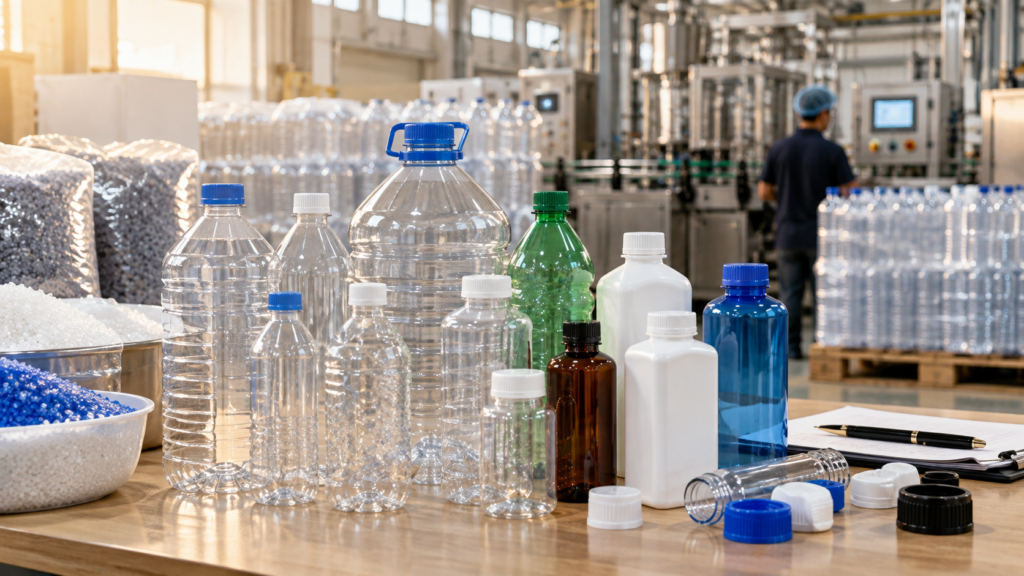
Start with the quantity of product you need to package. Smaller bottles may work well for samples, single-use products, travel products, or smaller retail sizes. Medium-sized bottles are common for everyday consumer products, while larger bottles may be appropriate for commercial, household, or bulk applications.

The physical dimensions matter too. A bottle may technically hold the required volume but still be unsuitable for your filling line, storage area, shipping cartons, or retail shelves.

Before ordering, check:

  • Overall height and width
  • Bottle capacity
  • Neck size
  • Opening diameter
  • Base dimensions
  • Weight
  • Compatibility with filling equipment
  • Space required for labels

Consider Bottle Design

You may choose between standard bottle shapes and customized designs.

Standard bottles are often a practical choice when cost and availability are priorities. They can also make replacement orders easier.

Custom shapes may be useful when you want packaging that gives your product a distinctive appearance. Ergonomic designs can also make bottles easier to hold and use.

Businesses that sell products requiring a wider opening may also consider plastic jar containers instead of conventional narrow-neck bottles. Jars can make filling and accessing certain products easier, particularly when the contents are solid, semi-solid, granular, or need to be removed with a spoon or by hand.

Check Product Compatibility and Safety Requirements

A plastic container is not automatically suitable for every product. The material, closure, shape, and manufacturing specifications should match what you intend to package.

Make Sure the Bottle Works With Your Product

Consider the characteristics of your product before selecting a bottle.

For example, packaging requirements may vary depending on whether the product contains:

  • Acids
  • Oils
  • Moisture
  • Alcohol-based ingredients
  • Chemicals
  • Food ingredients
  • Pharmaceutical formulations
  • Personal care ingredients

Temperature can also matter. Products that are filled, stored, or transported under particular temperature conditions may require packaging with appropriate material and dimensional properties.

The bottle should also maintain its shape and performance during normal storage and transportation.

Food and Pharmaceutical Applications

Food, beverage, pharmaceutical, and personal care products can have specific packaging requirements. Hygiene, material selection, manufacturing conditions, storage, and handling should all be considered.

If your product requires specific certifications, testing, or compliance documentation, ask the supplier to provide the relevant documents before placing the order.

Do not assume that every plastic bottle meets every regulatory or industry requirement. Confirm the specifications that apply to your product and market.

Compare Plastic Bottle Wholesale Pricing

Bulk purchasing can reduce the cost per bottle, but price should not be the only factor you compare.

A cheaper bottle may have different specifications, lower weight, fewer included components, or additional costs that are not obvious in the initial quotation.

Don’t Compare Price Alone

When requesting quotations, compare the complete cost.

Look at:

  • Unit price
  • Minimum order quantity
  • Cap and closure costs
  • Customization charges
  • Labeling or finishing costs
  • Packaging costs
  • Delivery charges
  • Mold or tooling costs, if applicable

For example, one supplier may quote a lower bottle price but charge separately for caps. Another may include the caps but have higher delivery costs.

A detailed quotation makes it easier to compare suppliers fairly.

Understand Bulk Pricing

Plastic Bottle wholesale purchasing can be particularly useful for businesses with predictable packaging requirements. When you regularly use thousands of bottles, purchasing larger quantities may improve your per-unit cost and reduce the need for frequent small orders.

Still, avoid ordering more than you can realistically store or use. Packaging inventory takes up warehouse space and ties up cash.

The ideal order quantity should balance price savings with your actual consumption and storage capacity.

Review Customization Options

Packaging is often one of the first things customers notice. A well-designed bottle can support your product’s presentation while also making it easier to use.

Build Packaging Around Your Brand

Depending on the supplier and production method, customization may include:

  • Custom bottle shapes
  • Different sizes
  • Colored plastic
  • Various cap styles
  • Custom molds
  • Label-friendly surfaces
  • Different finishes

The right design depends on your product and target customer.

For example, a beverage company may prioritize easy handling and secure closures, while a personal care business may focus more heavily on shape, appearance, and dispensing.

When Custom Bottles Make Sense

Custom bottles can be useful when you want to differentiate your product from similar items on retail shelves. They may also be worthwhile when your product requires a specific shape or opening.

However, customization can involve additional development, tooling, and production costs.

For smaller businesses or products with limited sales volume, a standard bottle may be more economical. For established product lines with predictable demand, custom packaging may provide greater value over time.

Discuss your expected quantity and design requirements with your supplier before investing in custom molds.

Evaluate Manufacturing Capacity and Delivery

A supplier may have the right bottle at the right price, but can they produce the quantity you need when you need it?

This becomes especially important when ordering thousands or tens of thousands of bottles.

Can the Supplier Handle Your Order?

Ask about:

  • Production lead time
  • Available stock
  • Monthly production capacity
  • Minimum order quantities
  • Delivery schedule
  • Repeat-order availability
  • Production consistency

Lead time can affect your entire production schedule. If your bottles arrive late, your filling, labeling, distribution, and sales activities may also be delayed.

A reliable Plastic Bottles manufacturer in Pakistan should be able to explain expected production timelines and discuss how repeat orders will be handled.

Think Beyond the First Order

Your first order is only one part of the relationship.

If you expect to reorder bottles regularly, consistency becomes very important. Bottle weight, dimensions, neck size, color, and other specifications should remain consistent between production batches.

Ask the supplier how specifications are maintained during repeat production.

It is also useful to discuss expected demand in advance. If your business is growing, your packaging supplier should understand the possibility of larger future orders.

Inspect Samples Before Placing a Large Order

One of the simplest ways to reduce purchasing risk is to test samples before placing a bulk order.

Photos and product descriptions can provide useful information, but they cannot tell you everything about how a bottle feels, performs, or works with your product.

Always Test Before Buying in Bulk

When samples arrive, check:

  • Bottle dimensions
  • Weight
  • Cap fit
  • Leakage
  • Strength
  • Appearance
  • Product compatibility
  • Label application
  • Filling performance
  • Sealing performance

If the bottle will be used on an automated filling line, test it with the actual equipment whenever possible.

Test the Bottle Under Real Conditions

Testing should go beyond simply looking at the sample.

Fill it with your actual product where practical. Close the bottle and observe how it behaves during storage and handling.

You can also test:

  • Stacking
  • Transportation
  • Vibration
  • Temperature exposure
  • Repeated handling
  • Label adhesion
  • Cap performance

These practical tests can reveal issues that may not be visible when examining an empty bottle.

Spending time testing a sample is far easier than discovering a problem after receiving a large shipment.

Plastic Bottles for Different Product Applications

The right packaging depends heavily on what you are selling. Different industries have different requirements for capacity, material, opening size, appearance, and closure type.

Plastic Juice Bottles

Plastic juice bottles need to be selected with beverage handling and storage in mind. The size should match the serving volume, while the closure should provide a secure seal.

Clear bottles can allow customers to see the beverage, while colored options may provide additional design flexibility.

Bottle shape also matters because beverages are frequently transported, displayed, and handled by customers. A practical design should be easy to hold while providing enough stability during storage and transportation.

Plastic Jar Containers

Plastic jar containers can be useful for products that need a wider opening or easier access.

They may be suitable for:

  • Spices
  • Confectionery
  • Pickles
  • Food products
  • Stationery
  • Craft materials
  • Other solid or semi-solid products

Different sizes and closure options allow businesses to select packaging according to the product and intended use.

Other Packaging Applications

Plastic bottles and jars are used across many industries, including:

  • Food products
  • Beverages
  • Spices
  • Pharmaceuticals
  • Personal care products
  • Household products
  • Stationery
  • Craft products

The key is to match the packaging specifications with the product instead of choosing a container based only on appearance or price.

Questions to Ask a Plastic Bottle Supplier Before Ordering

Before confirming a bulk order, ask the supplier these questions:

  1. What plastic material is used?
  2. What bottle sizes and shapes are available?
  3. What is the minimum order quantity?
  4. Do you offer samples before bulk production?
  5. Can the bottles be customized?
  6. What is the expected production lead time?
  7. Are caps included in the quoted price?
  8. Can you maintain consistent specifications for repeat orders?
  9. What delivery options are available?
  10. What quality or compliance documentation can you provide?

These questions can help you compare suppliers based on the complete purchasing process rather than simply looking at the unit price.

Final Thoughts

Ordering plastic bottles in bulk requires more planning than simply choosing a size and placing an order. Material quality, bottle design, product compatibility, pricing, customization, manufacturing capacity, and sample testing can all affect the success of your purchase.

For businesses with regular packaging requirements, working with an experienced Plastic Bottles manufacturer in Pakistan can make bulk purchasing easier, provided the supplier can consistently meet your required specifications, quantities, quality expectations, and delivery schedule.

Before placing your order, request samples and a detailed quotation. Confirm the bottle material, dimensions, cap specifications, minimum order quantity, lead time, and customization requirements.

Whether you need standard bottles, Plastic Bottle wholesale quantities, Plastic juice bottles, or plastic jar containers, choosing packaging based on your actual product requirements can help you avoid unnecessary costs and supply problems.

If you are planning a bulk order, discuss your required bottle size, material, quantity, closure type, customization needs, and intended application with your supplier before production begins.

Leave a Reply

Your email address will not be published. Required fields are marked *