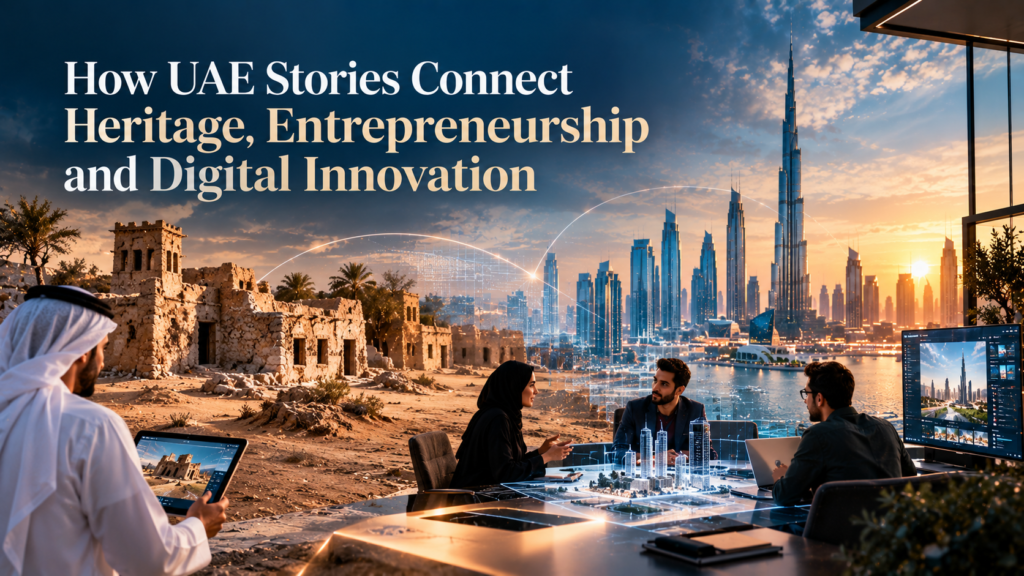
Learn how UAE heritage, entrepreneurship and property technology are connecting tourism, innovation and modern economic development across the country.
The UAE is often discussed through its modern cities, business districts, technology companies, tourism projects, and rapidly changing urban landscape. Yet the country’s identity also includes older communities, traditional settlements, desert environments, and cultural sites that provide a different perspective on how the region has developed.
This combination of heritage and modern development creates an interesting editorial opportunity. A story about an abandoned settlement can lead to discussions about changing lifestyles. A conversation about entrepreneurship can reveal how economic priorities are evolving. A technology story can show how innovation is influencing the way cities operate.
For a publication such as MAGNAV, these subjects do not need to exist in separate editorial categories. Business, technology, tourism, culture, and modern living can be connected through stories that explain how different parts of the UAE are changing.
From Desert Settlement to Digital Story
Among the UAE’s lesser-known heritage locations, Al Madam Ghost Village has attracted attention because of its unusual relationship with the surrounding desert. Sharjah’s tourism authority describes the site as a small abandoned village in the Al Madam area that has gradually been covered by desert sand. The settlement was developed as public housing after the formation of the UAE and was inhabited by members of a Bedouin community. The residents eventually left, with difficult environmental conditions and shifting desert sands cited as important factors.
The location provides more than an unusual visual experience. It offers an opportunity to think about how communities respond to environmental conditions, infrastructure, mobility, and changing economic circumstances.
Today, photographs of the partially buried homes circulate widely online. That digital attention has transformed the way people encounter the site. Someone living thousands of kilometres away can learn about the location through an article, photograph, video, or social media post without having visited the UAE.
This illustrates one of the most interesting features of modern tourism: digital storytelling can give historical and cultural locations a new audience.
Why Heritage Still Matters in a Modern Economy
Economic development does not remove the importance of historical places. In many cases, heritage becomes more valuable as cities modernize because it provides context for understanding what existed before today’s infrastructure and lifestyles.
The UAE’s development has taken place across a relatively short modern historical period, making the relationship between older settlements and contemporary cities particularly interesting.
A heritage site can therefore become part of conversations about tourism, photography, education, architecture, environmental adaptation, and regional history.
MAGNAV’s Art & Culture coverage can approach such subjects by providing context rather than relying only on visual appeal. A photograph may attract attention, but the historical explanation gives the reader a reason to understand the location more deeply.
Digital Media Is Changing Heritage Discovery
Travel research has moved far beyond printed guidebooks. People now use search engines, social platforms, video platforms, travel blogs, maps, and digital publications before deciding where to go.
This means heritage locations can become part of a much larger information ecosystem.
A reader may encounter a photograph first, search for additional information later, and then read a detailed article about the history of the location. This journey creates opportunities for publishers to provide reliable information at different stages of the discovery process.
The same principle applies to UAE Tourism content more broadly. Visitors are often looking for practical information, but they also want to understand the story behind a location.
Connecting Tourism With Economic Development
Tourism does not operate independently from the wider economy. Destinations require transportation, hospitality, food services, guides, photography, digital marketing, retail, infrastructure, and other supporting industries.
When a lesser-known location gains attention, the resulting interest can create opportunities for surrounding communities and businesses, although the impact depends on visitor numbers, management, accessibility, and local planning.
This is why destination storytelling should avoid presenting tourism as simply a matter of taking photographs. Responsible coverage can explain the historical background of a place and encourage visitors to approach it respectfully.
MAGNAV’s Tourism section can connect these destination stories with wider discussions around travel behavior and modern UAE tourism.
The New Generation of UAE Entrepreneurship
At the same time that heritage locations are receiving digital attention, the UAE is building a business environment focused strongly on entrepreneurship, technology, innovation, and new forms of enterprise.
The official UAE government platform highlights initiatives connected with entrepreneurship and SMEs, the digital economy, e-commerce, technology, and economic development. It also notes that the country has free zones supporting businesses across areas including fintech, logistics, media, ICT, agritech, and healthcare.
This creates an environment in which startups can operate across multiple industries.
Entrepreneurship is no longer limited to traditional trading companies. Technology has opened opportunities in financial services, property, logistics, healthcare, education, tourism, artificial intelligence, and digital media.
For readers interested in UAE business developments, understanding this wider environment is important because individual startups are influenced by regulations, infrastructure, investment, talent, technology, and consumer demand.
What Makes the UAE Startup Environment Different?
A startup environment is shaped by more than the number of newly established companies. It also depends on access to investors, business infrastructure, skilled professionals, regulatory systems, technology, customers, and opportunities for international expansion.
The UAE’s economic strategies include entrepreneurship and SME initiatives alongside broader digital-economy programs. This indicates that startup development forms part of a wider economic framework rather than being treated only as a technology-sector issue.
For founders, this can create opportunities to build companies that address regional problems while also targeting international markets.
For publishers, it creates a wide range of stories. Startup coverage can examine founders, funding, technology, product development, regulation, customer behavior, and the sectors where new companies are emerging.
From Startup Ideas to Real-World Infrastructure
One particularly important area is property technology.
Real estate is one of the sectors where digital tools can affect both businesses and consumers. Property platforms can improve how people search for homes, analyze markets, manage buildings, process transactions, and communicate with service providers.
The development of property technology also reflects a larger shift toward data-driven urban management.
When property systems become more digital, information can move faster between owners, developers, agents, regulators, financial institutions, and customers. This can potentially improve efficiency while also creating new questions around data quality, privacy, regulation, and consumer protection.
The Role of Regulation in Technology Adoption
Technology companies often need regulatory frameworks that allow experimentation while maintaining appropriate safeguards.
Dubai has developed Sandbox Dubai as a structured environment where innovators and companies can test products, services, business models, and technologies under adaptive regulatory supervision. Its PropTech Sandbox specifically focuses on technologies affecting the real estate sector.
This type of framework is significant because innovation does not happen only through private companies. Government agencies, regulators, technology providers, financial organizations, academic institutions, and developers can all influence how new systems are tested and adopted.
In November 2025, Dubai Future Foundation and Dubai Land Department announced a partnership focused on advancing PropTech innovation through Sandbox Dubai. The initiative includes testing emerging solutions and examining areas such as AI-driven analytics and smart building management.
The Middle of the Transformation: Startups Meet Real Estate
The connection between entrepreneurship and real estate becomes especially important when considering the UAE startup ecosystem as a broader network rather than simply a collection of technology companies.
Property technology provides an example of how startups can interact with established industries. A young company may develop a digital solution, but its adoption can depend on real estate companies, government regulators, financial institutions, developers, and customers.
This creates a more complex innovation environment.
It also shows why startup stories should not be separated from the industries they are trying to change. A PropTech company is part of the real estate sector. A fintech startup is connected to financial services. A travel technology company operates within tourism.
Understanding these relationships gives readers a clearer picture of how innovation moves from an idea into practical use.
AI and the Future of Property Services
Artificial intelligence is becoming an increasingly important component of technology development across industries.
In property, AI can potentially support market analysis, customer communication, building management, predictive maintenance, property search, and data interpretation. However, the usefulness of these applications depends on the quality of the underlying data and the way systems are implemented.
Dubai’s PropTech initiatives specifically mention AI-driven analytics and smart building management among areas where emerging technologies can be tested.
This suggests that property technology is moving beyond simple online listings toward systems that can interact with larger parts of the real estate process.
What Digital Property Platforms Mean for Consumers
For consumers, property technology can change how they search for and evaluate homes or investment opportunities.
Digital platforms can make information easier to access, while data tools can help users compare properties and understand market conditions. Digital processes can also reduce the need for paperwork and improve communication between different parties.
However, technology should not replace careful decision-making. Property remains a significant financial commitment, and users need to consider legal, financial, location, ownership, and market factors before making decisions.
This is where high-quality editorial coverage can help. A useful article should explain what a technology does without presenting it as a guaranteed solution.
Heritage and Innovation Can Exist Together
At first glance, an abandoned desert settlement and a technology-driven property sector may appear unrelated.
In reality, both can tell part of the UAE’s development story.
A historic settlement can show how communities once adapted to geography and environmental conditions. Modern technology can show how today’s businesses are adapting to new economic and digital conditions.
The contrast is valuable because it demonstrates how quickly lifestyles, infrastructure, and economic structures can change.
MAGNAV’s UAE News & Trends coverage can use this broader perspective to connect stories about heritage with developments in business, technology, tourism, and modern living.
Why Storytelling Matters for UAE Content
The UAE attracts global attention, but international readers may not always have enough context to understand individual stories.
A technology announcement may seem technical without an explanation of its wider importance. A heritage location may appear mysterious without historical background. A startup story may seem isolated unless readers understand the business environment around it.
Good editorial content fills these gaps.
It explains what happened, why it matters, how it connects to wider developments, and what readers should understand from it.
This is especially important for SEO because search users often arrive with specific questions. They need useful information rather than repeated keywords.
Building a Stronger Digital Knowledge Base
As more UAE-related information becomes available online, publishers have an opportunity to create organized knowledge around important subjects.
Articles about tourism can connect with culture. Business stories can connect with technology. Real estate content can connect with finance. Startup coverage can connect with innovation.
Over time, this creates a stronger editorial structure.
For MAGNAV, such an approach supports its wider categories while giving readers different routes through related topics.
A reader interested in Dubai property may also want to understand technology adoption. Someone researching tourism may be interested in heritage. An entrepreneur may want to understand the country’s technology infrastructure.
These connections make digital publishing more useful than isolated keyword-focused pages.
Looking Ahead
The UAE’s development story will continue to include both physical and digital transformation.
Heritage sites will remain valuable sources of historical understanding, while startups and technology companies will continue working on new products and services. Real estate will increasingly interact with data, artificial intelligence, digital platforms, and smart-city systems.
The challenge for publishers is to explain these changes in a way that remains accurate and accessible.
Rather than treating innovation and heritage as opposing subjects, modern editorial storytelling can show how both contribute to the understanding of a rapidly changing country.
Conclusion
The UAE’s digital future can be understood more clearly when it is connected with the country’s physical history and evolving communities. Heritage locations reveal how earlier generations lived and adapted, while entrepreneurship and technology show how new economic models are being developed.
The continuing development of Dubai proptech trends demonstrates another stage of this transformation, particularly as government bodies, real estate organizations, startups, and technology providers work on new approaches to property services and urban management.
For digital publishers, the opportunity is to bring these different subjects together through informative storytelling. When tourism, culture, entrepreneurship, real estate, and technology are explained with context, readers gain a more complete understanding of the UAE and the forces shaping its future.
FAQs
What is the significance of the abandoned village near Al Madam?
The abandoned settlement provides insight into an earlier period of community life in Sharjah’s Central Region. Sharjah’s tourism authority says the village was developed as public housing after the UAE’s formation and was later abandoned as difficult environmental conditions affected life there.
Why is heritage content important for UAE tourism?
Heritage content gives visitors historical context and helps them understand the cultural background of places they may encounter while traveling through the UAE.
What is a startup ecosystem?
A startup ecosystem is the wider network supporting new businesses, including founders, investors, regulators, customers, technology providers, universities, business infrastructure, and support programs.
What is PropTech?
PropTech refers to technology used across the real estate sector. It can include property platforms, data analytics, smart-building systems, digital transactions, AI applications, and other technology-enabled services.
How is Dubai supporting PropTech innovation?
Sandbox Dubai provides a structured environment for testing innovative products and business models. Its PropTech Sandbox focuses specifically on technologies that can improve efficiency, sustainability, and accessibility within Dubai’s real estate sector.
Why should heritage and technology be covered together?
They represent different parts of the UAE’s development story. Heritage provides historical context, while technology and entrepreneurship illustrate contemporary economic and social change.