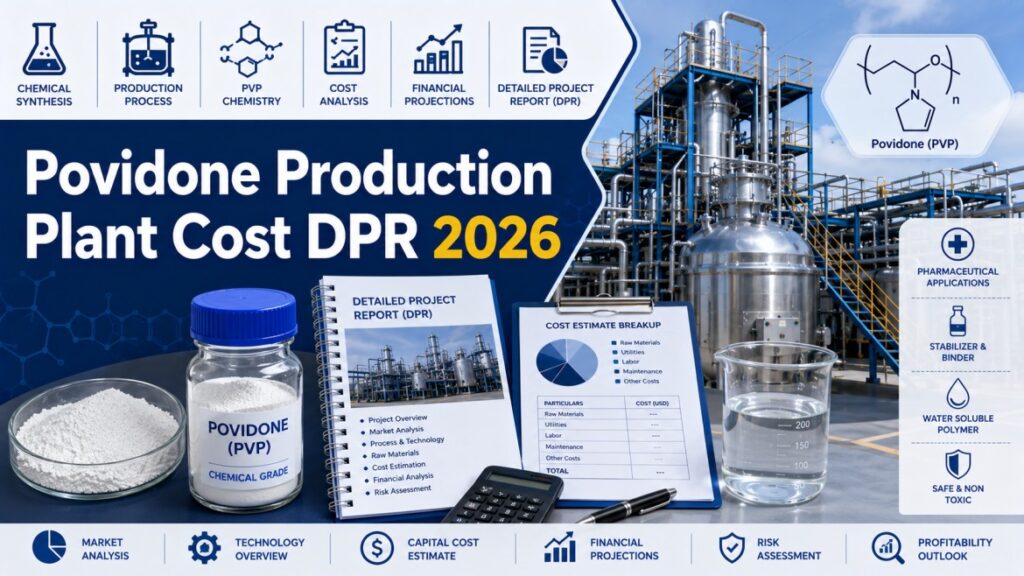
Setting up a povidone production plant offers manufacturers and entrepreneurs an opportunity to enter an established segment of the pharmaceutical excipients and specialty polymers industry, supported by consistent demand from tablet formulations, personal care products, industrial adhesives, and other specialized applications. Povidone is widely used for its binding, film-forming, stabilizing, and solubility-enhancing properties, making it an important ingredient across pharmaceutical and consumer product formulations. As applications continue to expand across pharmaceuticals, cosmetics, food-related processing, and industrial sectors, the povidone industry provides opportunities for businesses seeking to establish a presence in the specialty chemicals market and develop a diversified portfolio of high-value products.
IMARC Group’s Detailed Project Report (DPR) provides a complete roadmap for establishing a povidone production plant cost – covering market outlook, plant setup, machinery, raw materials, cost structure, and investment opportunities.
Global Market Outlook and Investment Opportunity:
The global povidone market demonstrates a steady growth trajectory, with volumes reaching 96.67 Thousand Tons in 2025. According to IMARC Group’s estimates, the market is expected to reach 161.94 Thousand Tons by 2034, exhibiting a CAGR of 5.9% from 2026 to 2034. This expansion is driven by rising demand across pharmaceutical, personal care, food and beverage, agricultural chemicals, adhesives, and water treatment applications.
Povidone, also known as polyvinylpyrrolidone (PVP), is a synthetic, water-soluble polymer widely used in pharmaceutical, cosmetic, and industrial applications. In medicines, it functions mainly as a binder that helps hold tablet ingredients together, as well as a solubilizing and stabilizing agent for active compounds. It is valued for its non-toxic nature, biocompatibility, and ability to dissolve in both water and alcohol. Beyond pharmaceuticals, povidone is found in personal care products like hair sprays and skin creams, and in industrial uses such as adhesives and coatings.
Key Investment Highlights:
- Process Used: Vinylpyrrolidone polymerization, purification, and spray drying.
- End-use Industries: Pharmaceuticals, personal care, food & beverage, agricultural chemicals, adhesives, water treatment.
- Applications: Used for tablet binders, hair styling products, wine clarification, crop protection formulations, adhesive intermediates, membrane filtration aids.
Plant Capacity and Production Scale:
The proposed povidone production facility is designed with an annual production capacity ranging between 5,000 – 15,000 tons, enabling economies of scale while maintaining operational flexibility. This capacity allows manufacturers to serve pharmaceuticals, personal care, food & beverage, agricultural chemicals, adhesives, and water treatment sectors – ensuring steady demand across multiple industry verticals.
Request for a Sample Report: https://www.imarcgroup.com/povidone-manufacturing-plant-project-report/requestsample
Factors Affecting Povidone Production Plant Cost:
The operating cost structure of a povidone production plant is primarily driven by raw material consumption, particularly vinyl pyrrolidone monomer, which accounts for approximately 60-70% of total operating expenses (OpEx), followed by utilities at 15-20% of OpEx. The remainder comprises transportation, packaging, salaries and wages, depreciation, taxes, and other expenses. As with any manufacturing project, the precise investment quantum varies by plant location, capacity, technology, and material sourcing strategy.
- Raw Materials: 60-70% of OpEx
- Utilities: 15-20% of OpEx
Capital investment for the plant is led by machinery costs, which account for the largest portion of total capital expenditure, followed by land and site development costs covering land registration, boundary development, and related expenses. Exact CapEx figures (Land and Site Development Costs, Civil Works Costs, Machinery Costs, and Other Capital Costs) and detailed OpEx line items are Transportation, Packaging, Salaries and Wages, Depreciation, Taxes, Other Expenses.
Speak to Analyst for a Customized Report: https://www.imarcgroup.com/request?type=report&id=9477&flag=C
Plant Setup Considerations: Step-by-Step Execution Plan:
- Site Selection: The location must offer easy access to key raw materials such as vinyl pyrrolidone monomer and initiators. Proximity to target markets helps minimize distribution costs, and the site must have robust infrastructure, including reliable transportation, utilities, and waste management systems, along with compliance with local zoning laws and environmental regulations.
- Plant Layout Optimization: The layout should be optimized to enhance workflow efficiency, safety, and minimize material handling, with separate areas designated for raw material storage, production, quality control, and finished goods storage, plus space for future expansion.
- Equipment Selection: High-quality, corrosion-resistant machinery tailored for povidone production must be selected, including polymerization reactors, solvent recovery units, filtration systems, drying ovens, milling machines, quality control analyzers, and packaging lines, all compliant with industry safety and efficiency standards.
- Raw Material Sourcing: Reliable suppliers must be secured for raw materials like vinyl pyrrolidone monomer and initiators to ensure consistent production quality, minimize transportation costs, and stabilize pricing through long-term contracts.
- Safety and Environmental Compliance: Safety protocols must be implemented throughout the production process, with advanced monitoring systems to detect leaks or deviations, and effluent treatment systems to minimize environmental impact and ensure compliance with emission standards.
- Quality Assurance Systems: A comprehensive quality management system should be implemented across all stages of operations, with appropriate testing, monitoring, validation, SOPs, documentation, traceability, and regular audits to support continuous improvement.
Machinery, Equipment, and Production Line Planning:
Key machinery for a povidone production plant includes polymerization reactors for vinylpyrrolidone conversion, solvent recovery units for process efficiency, filtration systems for purification, drying ovens for moisture removal, milling machines for particle sizing, quality control analyzers for compliance testing, and packaging lines for finished product handling.
Raw Material Sourcing and Supply Chain Strategy:
Vinyl pyrrolidone monomer and initiators serve as the primary raw materials for povidone production, with additional processing chemicals required depending on the desired molecular weight grade. Establishing long-term contracts with reliable suppliers of vinyl pyrrolidone monomer and initiators helps mitigate price volatility and ensures consistent raw material supply, given that raw materials alone account for the largest share of total operating expenditure.
Regulatory Compliance and Quality Standards:
Setting up a povidone production plant typically requires business registration, environmental clearances, factory licenses, fire safety certifications, and industry-specific permits, with local, state, and national regulations applying depending on the location. Compliance with pharmaceutical-grade and industrial-grade specifications creates entry barriers that favor efficient and experienced producers.
ROI and Profitability Analysis:
The povidone production business demonstrates healthy profitability potential under normal operating conditions, supported by stable demand and value-added applications:
- Gross Profit Margins: 30-40%
- Net Profit Margins: 15-22%
Break-even in a povidone production business typically ranges from 3 to 5 years, depending on production scale, energy costs, raw material availability, and market competition. Lower operating costs and bulk sales contracts can accelerate return on investment.
Buy Now: https://www.imarcgroup.com/checkout?id=9477&method=2175
How IMARC Group Supports Povidone Production Projects:
IMARC Group provides customized Detailed Project Reports (DPRs), feasibility studies, and end-to-end project execution support to help investors, pharmaceutical companies, and industrial manufacturers plan, budget, and execute povidone production projects across global markets – including market assessment, machinery selection guidance, regulatory navigation, and cost modeling tailored to specific plant locations and capacities.
Who Should Read This Report:
- First-time investors evaluating manufacturing diversification into pharmaceutical excipients
- Pharmaceutical and specialty chemical companies exploring backward or forward integration
- Personal care, food & beverage, and agrochemical companies seeking a dependable povidone supply chain
- Entrepreneurs and investors evaluating entry into the povidone production sector
Industry Leadership:
The global povidone industry is led by established players including BASF SE, Ashland Global Holdings Inc., Boai NKY Pharmaceuticals Ltd., Nippon Shokubai Co., Ltd., and JH Nanhang Life Sciences Co., Ltd. – serving pharmaceuticals, personal care, food & beverage, agricultural chemicals, adhesives, and water treatment sectors worldwide.
Recent Industry Developments:
2025: BASF SE introduced an upgraded Kollidon® povidone excipient formulation with improved compatibility across a wider range of active pharmaceutical ingredients, supporting more effective drug delivery for both oral and injectable formulations, alongside a biomass-balance approach aimed at more sustainable polymer production.
Frequently Asked Questions:
- What is the annual production capacity of the proposed plant?
The proposed facility is designed for an annual capacity ranging between 5,000 – 15,000 tons.
- What are the expected profit margins?
Gross profit margins typically range from 30-40%, with net profit margins of 15-22%, subject to plant-specific cost structures.
- What is the biggest cost driver in povidone production?
Raw materials – primarily vinyl pyrrolidone monomer – account for 60-70% of total operating expenditure, with utilities accounting for a further 15-20%, making supplier relationships and price contracts a critical planning priority.
- What raw materials are required for povidone production?
Povidone production requires raw materials such as vinyl pyrrolidone monomer and initiators. Depending on the desired molecular weight grade, additional processing chemicals may be needed.
About Us:
IMARC Group is a global management consulting firm that helps the world’s most ambitious changemakers create a lasting impact. The company excels in understanding its clients’ business priorities and delivering tailored solutions that drive meaningful outcomes. IMARC Group provides a comprehensive suite of market entry and expansion services, including market assessment, feasibility studies, company incorporation assistance, factory setup support, regulatory approvals and licensing navigation, branding, marketing and sales strategies, competitive landscape and benchmarking analyses, pricing and cost research, and procurement research.
Contact Us:
IMARC Group
134 N 4th St. Brooklyn, NY 11249, USA
Email: sales@imarcgroup.com
Tel No: (D) +91 120 433 0800
United States: (+1-201-971-6302)