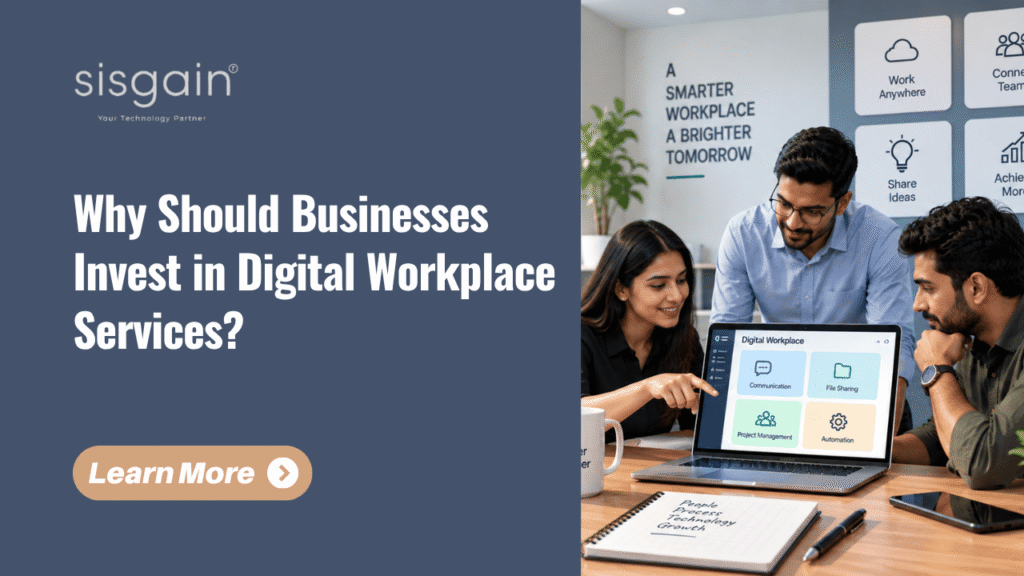
Work has changed dramatically. Employees are no longer tied to one office, one computer, or one communication channel. Teams now work across offices, homes, client locations, and different time zones while depending on a growing collection of digital tools to keep everything moving.
This shift has created a new business challenge: having many digital tools does not automatically create a productive workplace. Employees can have dozens of applications open and still spend valuable time searching for information, switching between platforms, repeating tasks, or waiting for approvals.
This is where digital workplace services become important. They bring together collaboration tools, communication platforms, business applications, automation, cloud technologies, employee workflows, and security into a more connected working environment.
For businesses in the USA, the goal is not simply to digitize every process possible. It is to create a workplace where technology quietly removes friction instead of becoming another source of it. After all, software should make work easier—not turn employees into professional tab-switchers.
What Are Digital Workplace Services?
Digital workplace services refer to technology solutions that help employees communicate, collaborate, access information, manage tasks, and perform their daily responsibilities through connected digital platforms.
These services can include much more than video meetings or cloud storage. A modern workplace may combine employee portals, document management, workflow automation, enterprise applications, communication platforms, analytics, cybersecurity, mobile access, and artificial intelligence.
A typical digital workplace can involve:
- Collaboration and communication platforms
- Cloud-based business applications
- Employee self-service portals
- Workflow and task automation
- Digital document management
- Enterprise mobility
- Knowledge management
- Identity and access management
- Business analytics
- AI-powered productivity tools
The exact combination depends on the organization’s size, industry, workforce structure, and existing IT environment. A startup may need a lightweight cloud-based setup, while a large enterprise may require extensive integrations across departments and locations.
Why Is the Digital Workplace Becoming a Business Priority?
Businesses increasingly compete on how quickly they can make decisions, respond to customers, share information, and adapt to changing market conditions. Technology directly affects all of these areas.
A disconnected workplace can create small inefficiencies that become expensive at scale. An employee may spend ten minutes searching for a document, another employee may manually enter information into two systems, and a manager may wait for several approvals before a simple request moves forward.
Individually, these delays look harmless. Across hundreds or thousands of employees, they can become a significant productivity problem.
Well-planned digital workplace services can help organizations create a more connected environment where information moves more efficiently between people, applications, and departments. The value comes from removing friction rather than simply adding technology.
How Can Digital Workplace Tools Improve Employee Productivity?
Productivity is often discussed as if employees simply need to work faster. In reality, productivity can improve when unnecessary steps disappear from the workday.
Imagine an employee who needs information from three different systems before completing a routine task. If those systems are connected and the required information appears through a unified interface, the employee can spend less time navigating technology and more time completing the actual work.
Automation can create another layer of efficiency. Routine approval requests, notifications, document routing, employee onboarding steps, and service requests can follow predefined workflows instead of depending entirely on manual coordination.
Useful productivity improvements may include:
- Automated repetitive tasks
- Centralized access to information
- Faster internal communication
- Easier document sharing
- Simplified approval workflows
- Better employee self-service
- Improved access from mobile devices
A productive digital workplace should feel simpler, not more complicated.
Can IoT Become Part of a Digital Workplace?
Yes. The workplace is not only made up of laptops and software. Offices, buildings, equipment, meeting rooms, security systems, and other physical assets can also become part of the digital environment.
An IoT application development agency can create applications that connect sensors and physical devices with business software. For example, sensors can monitor room occupancy, temperature, energy usage, equipment status, or environmental conditions.
This information can support workplace management in practical ways. A facilities team could identify underused spaces, receive equipment alerts, or monitor energy consumption through a centralized application.

The connection between IoT and the workplace can include:
- Smart meeting rooms
- Occupancy monitoring
- Connected office equipment
- Energy management
- Environmental monitoring
- Workplace safety systems
- Asset tracking
An iot application development agency may also integrate connected devices with dashboards, mobile applications, analytics platforms, and existing enterprise systems.
The important consideration is relevance. A workplace does not need sensors everywhere simply because sensors are available. Each connected device should have a clear purpose.
How Can VR Improve Workplace Training?
Training becomes more challenging when employees need to learn physical procedures, complex equipment, safety practices, or environments that are difficult to recreate in a classroom.
This is where VR development solutions can provide an alternative training environment. Virtual Reality creates a computer-generated environment where employees can practice tasks and procedures using compatible headsets and controllers.
Potential applications include:
- Safety training
- Equipment operation
- Emergency response preparation
- Technical training
- Employee onboarding
- Customer-service simulations
- Workplace procedure practice
For example, an organization could create a virtual simulation of a technical environment where employees practice procedures without interacting with expensive or potentially hazardous equipment.
VR development solutions can also support repeatable training. Employees can practice the same process multiple times, which can be difficult to achieve with physical training environments.
VR is not appropriate for every learning requirement, but it can be valuable when realistic simulation provides an advantage over traditional training methods.
Can Blockchain Support Workplace Processes?
Blockchain may have a role in specific workplace applications where verification, shared records, digital ownership, or trusted transactions are important.
blockchain development and consulting can help businesses evaluate whether blockchain is technically and commercially appropriate before introducing it into workplace systems.
For example, organizations could explore blockchain-based solutions for verifying professional credentials, managing certain digital assets, or maintaining shared records between multiple parties.
However, blockchain should not be added simply because it is considered innovative. A conventional database may be more appropriate when one organization controls the information and does not require a distributed record.
Good blockchain development and consulting focuses on the business problem first and the technology second. That distinction can prevent unnecessary complexity and help organizations invest in technology for the right reasons.
Why Does IT Service Management Matter in a Digital Workplace?
A modern workplace depends heavily on technology, which means employees also depend on reliable IT services.
When an application stops working, an employee loses access, or a system requires an update, there needs to be a structured process for resolving the issue. This is where IT Service Management, commonly called ITSM, becomes relevant.
ITSM is the structured approach businesses use to design, deliver, manage, and improve IT services. It can cover areas such as incident management, problem management, change management, service requests, asset management, knowledge management, and service monitoring.
IT service management business consulting can help organizations evaluate these processes and create service structures that align technology operations with business requirements.
Instead of treating every IT issue as an isolated problem, organizations can build repeatable processes for handling common requests and more serious incidents.
How Can ITSM for Business Growth Support an Organization?
Technology management directly affects business continuity. If employees cannot access important systems or customers cannot use critical digital services, productivity and revenue can both be affected.
ITSM for Business Growth focuses on creating IT processes that can support business expansion rather than becoming a bottleneck.
For example, as a company grows, it may need structured employee onboarding, application access management, device provisioning, service requests, and change controls. Without defined processes, IT teams can become overloaded with repetitive requests.
A mature ITSM approach can help businesses:
- Standardize service processes
- Improve incident response
- Track recurring technical problems
- Manage technology changes
- Improve employee support
- Create measurable service performance
- Align IT operations with business priorities
This is where IT service management business consulting can be useful. External expertise can help organizations identify gaps and establish processes that fit their operational model.
What Role Does IT Consulting Play in Digital Workplace Planning?
A digital workplace rarely consists of one application. It may involve cloud platforms, collaboration software, employee portals, HR systems, CRM platforms, security tools, IoT devices, analytics, and multiple third-party applications.
Without proper planning, these technologies can become disconnected islands.
IT consulting management can help businesses evaluate their technology environment, identify integration opportunities, plan digital initiatives, and align technology investments with operational goals.
For example, before introducing a new employee platform, a business may need to determine how it will connect with identity management, HR software, document repositories, communication tools, and existing security controls.
This type of planning can reduce duplication and help businesses make better technology decisions.
How Can Digital Workplace Services Support Remote and Hybrid Teams?
Remote and hybrid work require more than a video-conferencing application. Employees need reliable access to documents, business systems, communication channels, workflows, and support services regardless of where they work.
A well-designed digital workplace can provide a consistent environment for distributed teams. Employees can access approved applications, collaborate on documents, submit requests, communicate with colleagues, and participate in workflows through connected platforms.
Security is especially important here. Remote access should be supported by appropriate authentication, authorization, device management, data protection, and monitoring.
Organizations should also consider employee experience. If remote workers need to remember five different passwords, search across multiple disconnected systems, and manually request information from different departments, the technology stack is creating friction rather than removing it.
What Security Measures Should a Digital Workplace Include?
The more connected a workplace becomes, the more important security becomes. A modern workplace can contain employee information, business documents, customer data, intellectual property, financial records, and confidential communications. Protecting these resources requires multiple layers of security.
Important considerations include:
- Multi-factor authentication
- Role-based access controls
- Encryption
- Endpoint protection
- Secure cloud configuration
- Identity management
- Regular security monitoring
- Employee security awareness
- Backup and recovery planning
Security should also be considered during application integration. Connecting two systems creates convenience, but it can also create another pathway that needs appropriate protection.
How Should Businesses Choose the Right Digital Workplace Strategy?
Choosing a digital workplace strategy depends on how employees work, what tools they already use, and where current processes create delays. Businesses should first identify gaps in communication, collaboration, data access, and routine tasks instead of adopting technology simply because it is trending.
A practical strategy should also consider scalability, security, employee experience, and integration with existing systems. The right approach may include cloud-based tools, workflow automation, collaboration platforms, or better knowledge management, depending on the organization’s actual needs.
Before implementation, businesses can evaluate:
- Business goals: What outcomes should the strategy improve?
- Employee needs: Which daily tasks or workflows need better support?
- Technology integration: Can new tools work smoothly with existing systems?
- Security: How will company data and user access be protected?
- Scalability: Can the workplace environment support future growth?
A well-planned strategy focuses on solving real workplace challenges while creating a flexible environment that can adapt as business needs change.
What Future Technologies Could Shape the Digital Workplace?
The next phase of workplace technology will likely involve deeper integration between AI, automation, IoT, immersive technologies, cloud platforms, and enterprise applications.
AI assistants may help employees find information, summarize documents, automate routine tasks, and interact with business systems using natural language.
IoT can connect physical workplaces with software platforms, while immersive technologies can support training and remote assistance.
Blockchain may continue to find selective applications where trusted records or digital verification are important.
At the same time, businesses will need stronger governance. More technology means more data, more integrations, and potentially more security responsibilities.
The future digital workplace will therefore not be defined by the number of tools a company uses. It will be defined by how intelligently those tools work together.
What Could SISGAIN Bring to a Business Technology Strategy?
SISGAIN provides software development and technology solutions designed around practical business requirements. Its capabilities cover enterprise applications, cloud solutions, IoT, blockchain, AR/VR, AI, and custom software development. This broad technical experience can help organizations manage projects where multiple technologies need to work together. For businesses looking to modernize operations, improve application connectivity, or develop new digital products, SISGAIN can provide technical expertise across planning, development, integration, deployment, and ongoing support.

Conclusion
A successful digital workplace is not simply about adding more tools. It is about creating a connected, secure, and flexible work environment that supports employees and business goals.
By understanding current challenges, employee needs, technology requirements, and future growth plans, businesses can build a strategy that delivers practical value. A thoughtful approach also makes it easier to improve processes, support collaboration, and adapt to changing workplace expectations.
FAQs
1. What can an IoT application development agency offer businesses?
An IoT application development agency can build connected applications that collect, monitor, and analyze device data. These solutions can support automation, tracking, and smarter business operations.
2. What are VR development solutions used for?
VR development solutions help businesses create immersive experiences for training, product visualization, education, simulations, and customer engagement.
3. When do businesses need blockchain development and consulting?
Blockchain development and consulting can help businesses explore secure, transparent, and decentralized solutions for areas such as transactions, data sharing, and digital records.
4. How can digital workplace services support modern teams?
Digital workplace services help organizations improve collaboration, communication, information access, and everyday workflows through connected digital tools and platforms.
5. What does IT service management business consulting involve?
IT service management business consulting helps organizations improve IT processes, service delivery, support workflows, and technology alignment with broader business goals.