Moisture can cause serious problems for products during storage, packaging, and transportation. Electronics can develop corrosion, metal parts can rust, leather can deteriorate, documents can become damaged, and food and pharmaceutical packaging may be affected by unwanted humidity.
One simple solution used across many industries is silica gel desiccant. These small moisture-absorbing packets or containers are commonly placed inside product packaging to help control humidity and protect goods from moisture-related damage.
Despite its familiar appearance, silica gel is often misunderstood. Some people think it is a type of gel, while others assume that every silica gel packet works in exactly the same way. In reality, different grades, packet sizes, packaging materials, and formulations are designed for different applications.
This guide explains what silica gel desiccant is, how it works, where it is used, how to choose the right product, storage requirements, safety considerations, packaging options, and frequently asked questions.
What Is Silica Gel Desiccant?
Silica gel is a porous form of silicon dioxide that can adsorb moisture from the surrounding air.
A desiccant is a material used to reduce or control humidity.
When silica gel is placed inside a sealed package, its porous structure attracts and holds water vapour. This helps lower the relative humidity inside the packaging environment.
Silica gel is commonly supplied as:
- Sachets
- Packets
- Canisters
- Capsules
- Breather bags
- Bulk granules
- Custom-shaped moisture absorbers
The product selected depends on the amount of moisture that needs to be controlled and the type of packaging being used.
How Does Silica Gel Work?
Silica gel works through adsorption.
This is different from absorption.
Absorption occurs when a substance is taken into the interior of another material, while adsorption involves molecules adhering to a surface.
Silica gel contains a network of microscopic pores that provide a large surface area.
Water vapour from the surrounding air comes into contact with this porous surface and is held within the silica gel structure.
This makes it useful for controlling humidity inside enclosed spaces.
The effectiveness of a desiccant depends on several factors, including:
- Amount of silica gel
- Package volume
- Initial humidity
- Temperature
- Packaging material
- Seal quality
- Exposure time
- Product moisture sensitivity
A small packet may be sufficient for a small box, while larger packaging may require a larger quantity.
Why Is Silica Gel Used for Moisture Control?
Moisture can damage products in several ways.
Depending on the product, excess humidity can cause:
- Rust
- Corrosion
- Mould growth
- Odours
- Material degradation
- Electrical problems
- Packaging damage
- Reduced shelf life
Using a desiccant can help create a drier environment inside sealed packaging.
For businesses, this can be particularly valuable during long-distance transportation or extended storage.
Common Applications of Silica Gel Desiccant
Silica gel is used in many industries because moisture control is important across different product categories.
Electronics
Electronic components can be sensitive to moisture.
Humidity can contribute to corrosion and other forms of damage, particularly when products are stored or transported through changing environmental conditions.
Desiccant packets can be placed inside suitable packaging to help control moisture.
Common applications include:
- Circuit boards
- Cameras
- Sensors
- Electrical components
- Consumer electronics
- Computer accessories
The desiccant should be used as part of an appropriate packaging system.
Pharmaceuticals
Moisture can affect the stability and quality of certain pharmaceutical products.
Desiccants may be included in medicine bottles, blister packaging, or other sealed containers when humidity control is required.
Pharmaceutical applications require careful consideration of product specifications, regulatory requirements, packaging compatibility, and safety.
Not every silica gel product is automatically suitable for pharmaceutical use.
Food Packaging
Certain packaged foods can benefit from moisture control.
Desiccants may help protect dry products from unwanted humidity where the packaging and product design allow their use.
However, the desiccant must be appropriate for the intended food-packaging application.
It should never be treated as an ingredient.
Leather Products
Leather can be affected by moisture during storage and shipping.
Excess humidity can contribute to mould, odours, and deterioration.
Desiccant packets may be included with:
- Shoes
- Handbags
- Belts
- Wallets
- Leather accessories
The amount required depends on the packaging and storage conditions.
Clothing and Textiles
Moisture can cause unpleasant odours and contribute to mould under unsuitable storage conditions.
Silica gel packets can help manage humidity inside sealed packaging for some textile products.
They are often used with products that are shipped or stored for extended periods.
Metal Products
Metal components are particularly vulnerable to corrosion in humid environments.
Desiccants can help reduce humidity inside sealed packaging and support corrosion-control strategies.
They may be used with:
- Tools
- Hardware
- Machinery components
- Automotive parts
- Precision instruments
- Metal products
For long-term corrosion protection, desiccants may be combined with other packaging and corrosion-inhibiting methods.
Silica Gel Packets
Silica gel packets are one of the most familiar forms of desiccant.
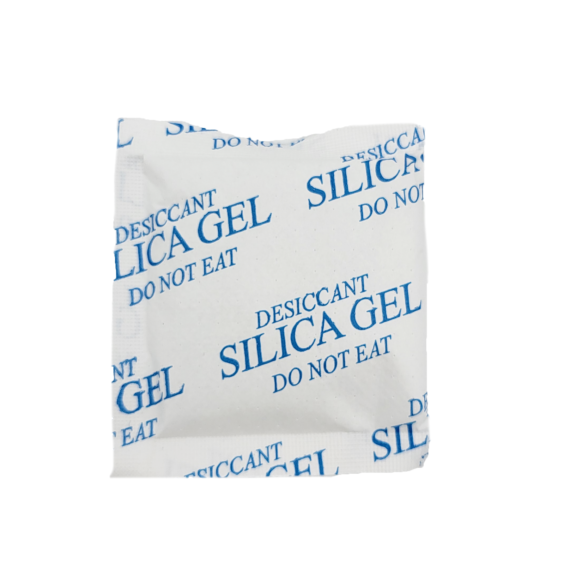
A small sachet contains silica gel beads or granules inside a breathable packet material.
The packet allows water vapour to reach the silica gel while keeping the desiccant contained.
Packet sizes vary.
A small packet may be suitable for a shoe box or small electronics package, while larger packets may be used for bigger containers.
Choosing the right packet size is important.
Using too little desiccant may provide insufficient moisture control, while excessive quantities may increase cost without providing a meaningful benefit.
Indicator Silica Gel
Some silica gel products contain a humidity indicator.
Indicator desiccants can change colour as moisture is adsorbed, depending on the indicator formulation.
This provides a visual way to assess the approximate moisture condition of the desiccant.
Indicator products can be useful when users need a simple visual indication of whether the desiccant has become loaded with moisture.
However, colour indicators should be interpreted according to the manufacturer’s instructions.
Different indicator systems use different colours and transition points.
Non-Indicating Silica Gel
Non-indicating silica gel does not change colour to show moisture loading.
It can still adsorb water vapour effectively.
This type may be suitable when visual monitoring is not required.
Non-indicating products can also be useful when a simple, economical moisture-control solution is preferred.
Food-Grade and Pharmaceutical Applications
Businesses should pay close attention to product specifications when desiccants are used around food, medicine, or other sensitive products.
A general industrial silica gel packet should not automatically be assumed to meet the requirements for direct or indirect food or pharmaceutical applications.
Look for appropriate documentation, packaging specifications, and supplier information.
The desiccant itself should remain contained and should not be consumed.
Is Silica Gel Toxic?
Silica gel itself is generally considered chemically stable and is widely used as a desiccant.
However, individual products can contain different additives or indicators, so the exact product should be checked.
The packet should not be opened or consumed.
The familiar “Do Not Eat” warning found on many silica gel packets exists because the packet is not intended to be eaten and may contain a product that is not suitable for consumption.
Keep desiccant products away from children and pets.
If a desiccant packet is swallowed, follow appropriate medical or poison-information guidance rather than assuming the product is harmless.
Silica Gel Desiccant and Electronics
Electronics are often shipped across different climates.
A product may move from a dry warehouse to a humid shipping environment and then into another climate.
Temperature changes can also cause condensation inside packaging.
Desiccants can help manage moisture vapour within appropriately sealed packaging.
However, silica gel is not a substitute for proper packaging design.
For moisture-sensitive electronics, businesses may also consider:
- Moisture-barrier bags
- Vacuum packaging
- Humidity indicators
- Protective cushioning
- Appropriate sealing
The correct combination depends on the sensitivity of the product and shipping conditions.
Silica Gel for Rust Prevention
Rust and corrosion are major concerns for metal products.
Even when a product is clean and dry during packaging, moisture entering the package can create a humid environment.
A desiccant can help reduce water vapour and therefore support corrosion-control efforts.
For valuable or highly sensitive metal components, businesses may combine desiccants with:
- Corrosion-inhibiting paper
- Vapour corrosion inhibitors
- Moisture-barrier packaging
- Protective coatings
- Proper sealing
Desiccant quantity should be selected according to the package volume and expected exposure.
How to Choose the Right Silica Gel Desiccant
There is no single product suitable for every application.
Consider the following factors.
Package Size
Larger packaging generally requires more moisture-control capacity.
Product Sensitivity
Highly moisture-sensitive products may require more comprehensive packaging.
Storage Duration
Long-term storage can require a different approach from short-term shipping.
Environmental Conditions
Humidity and temperature during transportation and storage can affect requirements.
Packet Size
Choose a packet size appropriate for the packaging environment.
Indicator Requirements
Indicator silica gel may be useful when visual monitoring is important.
Packaging Material
A desiccant cannot effectively control moisture if the packaging allows excessive moisture exchange with the outside environment.
How Much Silica Gel Do You Need?
The required amount depends on the application.
Factors include:
- Internal package volume
- Packaging material
- Product moisture content
- Expected humidity
- Storage duration
- Transportation conditions
- Required relative humidity
For simple consumer packaging, manufacturers may specify a recommended packet size.
For industrial applications, desiccant requirements may need to be calculated based on packaging specifications and expected environmental exposure.
It is better to use manufacturer guidance than to guess the quantity.
Silica Gel Desiccant for Shipping
Shipping can expose products to changing humidity levels.
A container may travel through several climate zones before reaching its destination.
Desiccants can help control moisture inside sealed packaging during transportation.
They are commonly used with:
- Export goods
- Electronics
- Machinery parts
- Automotive components
- Leather goods
- Clothing
- Pharmaceuticals
- Packaged products
For overseas shipping, the packaging system should be designed to handle the expected transportation conditions.
Desiccant selection is only one part of export moisture protection.
Silica Gel for Storage
Long-term storage presents different challenges from shipping.
Products may remain inside warehouses, containers, cabinets, or boxes for months.
If the storage environment is humid, moisture can gradually enter packaging.
Desiccants can help maintain a lower-humidity environment inside suitable sealed packaging.
Regular inspection may be appropriate for products that require long-term protection.
Can Silica Gel Be Reused?
Some silica gel products can be regenerated by removing the moisture they have adsorbed.
This is generally done through controlled heating according to the manufacturer’s instructions.
However, not every silica gel packet should be heated.
The packet material, indicator, additives, and product design may not be suitable for regeneration.
Never place an unknown silica gel packet in an oven or microwave.
If regeneration is permitted, follow the manufacturer’s specific temperature and handling instructions.
How to Store Silica Gel Before Use
Unused silica gel should be protected from moisture.
If packets are left exposed to humid air for long periods before use, they may adsorb moisture and lose some of their available capacity.
Keep unused products:
- In sealed packaging
- In a dry environment
- Away from water
- Away from high humidity
- Away from contamination
- According to supplier instructions
Opening bulk packaging only when required can help preserve the remaining product.
Silica Gel Desiccant vs Other Desiccants
Silica gel is one of several materials used for moisture control.
Other desiccants include:
- Molecular sieves
- Activated clay
- Calcium chloride
- Activated alumina
Each material has different characteristics.
Silica gel is widely used because it can adsorb moisture over a broad range of humidity conditions and is available in convenient packet and bulk formats.
Molecular sieves can provide very low humidity levels and may be selected for specialised applications.
Calcium chloride can absorb significant amounts of moisture but behaves differently from silica gel.
The correct desiccant depends on the required humidity level, package design, temperature, and application.
Common Mistakes When Using Silica Gel
Using Too Little Desiccant
Insufficient quantity may not provide the desired moisture control.
Leaving Packaging Unsealed
If humid outside air constantly enters the package, the desiccant may become saturated quickly.
Choosing the Wrong Product
Not every silica gel product is appropriate for food, pharmaceuticals, chemicals, or other specialised uses.
Ignoring Storage Conditions
Poor storage can expose unused desiccant to moisture before it is used.
Assuming Silica Gel Prevents All Moisture Problems
A desiccant works best as part of a properly designed packaging system.
Heating Packets Without Checking Instructions
Some packets are not designed to be regenerated.
Ignoring Product Documentation
Industrial applications may require specific specifications or certifications.
Silica Gel Desiccant for Businesses
Businesses that use desiccants regularly should consider their supply requirements carefully.
Factors to review include:
- Monthly usage
- Packet sizes
- Product specifications
- Packaging
- Storage capacity
- Supplier lead times
- Bulk order quantities
- Product consistency
Buying in bulk can make sense for businesses with high consumption.
However, large quantities should be stored properly and protected from humidity.
How to Choose a Silica Gel Supplier
A reliable supplier should provide clear information about the product.
Ask about:
- Silica gel type
- Packet sizes
- Indicator options
- Moisture capacity
- Packaging
- Intended applications
- Shelf life
- Storage conditions
- Bulk quantities
- Delivery times
- Product documentation
If the desiccant is being used for a regulated or sensitive application, ask for the relevant technical documentation before purchasing.
Silica Gel Packaging Options
Packaging is an important part of the product.
Common options include:
- Paper sachets
- Non-woven sachets
- Tyvek-style packaging
- Canisters
- Breathable containers
- Bulk granules
The packet material needs to allow moisture vapour to reach the silica gel while keeping the granules contained.
For industrial applications, the packaging material should also be suitable for the environment and intended use.
Sustainability and Silica Gel
Desiccants are often used as disposable packaging components, so businesses may consider their environmental impact.
Some products can potentially be regenerated and reused when the manufacturer allows it.
Other ways to reduce waste include:
- Ordering appropriate quantities
- Avoiding unnecessary disposal
- Using suitable packet sizes
- Improving storage
- Selecting reusable formats where appropriate
Businesses should follow the supplier’s instructions when deciding whether a desiccant can be regenerated or reused.
Silica Gel Desiccant: Final Thoughts
Silica gel desiccant is a practical moisture-control solution used across many industries.
Its porous structure allows it to adsorb water vapour, helping protect moisture-sensitive products during storage, shipping, and packaging.
It can be used with electronics, pharmaceuticals, food packaging, leather goods, textiles, metal components, tools, machinery, and many other products where humidity needs to be controlled.
However, the right desiccant depends on the application.
Businesses should consider package size, product sensitivity, storage duration, environmental conditions, packet size, packaging material, and the required humidity level before selecting a product.
Indicator silica gel can provide a visual moisture indication, while non-indicating products offer a straightforward solution where monitoring is not necessary.
It is also important to understand that silica gel works best as part of an appropriate packaging system. A poorly sealed package can allow moisture to enter continuously, reducing the effectiveness of the desiccant.
For sensitive products, moisture-barrier packaging, humidity indicators, corrosion protection, or other methods may need to be used alongside silica gel.
Businesses should also pay attention to product specifications when using desiccants around food, medicines, chemicals, or other regulated products.
Before placing a bulk order, ask the supplier about moisture capacity, packet sizes, packaging, intended applications, storage requirements, and available documentation.
When selected and used correctly, silica gel can be a simple and effective way to help manage humidity and protect products from moisture-related damage.
Frequently Asked Questions
What is silica gel desiccant?
Silica gel desiccant is a porous form of silicon dioxide used to adsorb moisture from the surrounding air. It is commonly supplied in packets, sachets, canisters, and bulk granules.
How does silica gel absorb moisture?
Technically, silica gel adsorbs moisture rather than absorbing it. Water vapour attaches to the extensive internal surface of the porous silica gel structure.
What is silica gel used for?
It is used to control moisture in packaging and storage for products such as electronics, pharmaceuticals, leather goods, textiles, metal components, food products, and other moisture-sensitive items.
Are silica gel packets safe?
Silica gel is generally stable, but packets are not intended to be eaten. Individual products may contain different additives or indicators, so the manufacturer’s information should be checked.
Why do silica gel packets say “Do Not Eat”?
The warning indicates that the packet and its contents are not intended for consumption. The packet may also contain additives or indicators that are not suitable for eating.
Can silica gel prevent rust?
Silica gel can help reduce humidity inside suitable sealed packaging, which can support corrosion-control efforts. For sensitive metal products, it may need to be combined with other corrosion-protection methods.
Can silica gel be used with electronics?
Yes. Desiccants are commonly used with moisture-sensitive electronics and components. The desiccant should be used with suitable moisture-control packaging.
How much silica gel do I need?
The required amount depends on package volume, humidity, storage duration, packaging permeability, and product sensitivity. Follow supplier or manufacturer recommendations where available.
Can silica gel be reused?
Some silica gel can be regenerated by controlled heating, but not every packet is designed for this. Check the manufacturer’s instructions before attempting to dry or reuse a product.
Can I heat silica gel packets?
Do not heat an unknown packet. Some packet materials, indicators, or additives may not be suitable for heating. Only regenerate silica gel when the manufacturer provides appropriate instructions.
Does silica gel expire?
Silica gel itself can remain usable for a long time when stored correctly, but packaged products may have manufacturer-specific shelf-life or storage recommendations.
How should unused silica gel be stored?
Keep unused silica gel in sealed packaging and protect it from moisture and high humidity until it is ready for use.
What is indicator silica gel?
Indicator silica gel contains a moisture-sensitive indicator that changes colour as moisture is adsorbed. The specific colour change depends on the indicator system used.
What is non-indicating silica gel?
Non-indicating silica gel does not change colour when it becomes moisture-loaded. It is used when a visual moisture indicator is not required.
Is silica gel suitable for food packaging?
Some desiccant products are specifically designed for food-packaging applications. Businesses should confirm that the particular product meets the requirements of its intended use.
Can silica gel be used with medicine?
Certain desiccant products are used in pharmaceutical packaging, but the product must be suitable for the specific application and meet relevant packaging and quality requirements.
What is the difference between silica gel and a desiccant?
Silica gel is a specific material, while desiccant is a general term for a substance used to control moisture.
What is the difference between absorption and adsorption?
Absorption involves a substance entering the bulk of another material. Adsorption involves molecules attaching to a surface. Silica gel primarily adsorbs water vapour.
Is silica gel better than other desiccants?
There is no universal best desiccant. Silica gel, molecular sieves, clay, and calcium chloride have different characteristics and are selected according to the application.
Can silica gel protect products during shipping?
Yes. It can help control moisture inside suitable sealed packaging during transportation. For international shipping, the overall packaging system should be designed for the expected climate and transit conditions.
What makes a good silica gel supplier?
A good supplier should provide consistent product quality, clear specifications, suitable packet sizes, reliable packaging, dependable delivery, and relevant technical information for specialised applications.
Can I buy silica gel desiccant in bulk?
Yes. Bulk silica gel is available in different packet sizes, canisters, and granule formats. Businesses should select quantities based on usage, storage capacity, and product shelf life.
How should silica gel be disposed of?
Follow the manufacturer’s disposal instructions and applicable local waste requirements. Products that have been exposed to chemicals or hazardous substances may require special handling.
Can silica gel eliminate all moisture?
No. Silica gel has a finite moisture capacity. Its effectiveness also depends on the quality of the packaging seal and the amount of moisture entering the package.
How long does silica gel last?
Its useful life depends on how much moisture it encounters, package conditions, temperature, and the amount of desiccant used. Once its moisture capacity is reached, it may need replacement or regeneration if the product allows it.