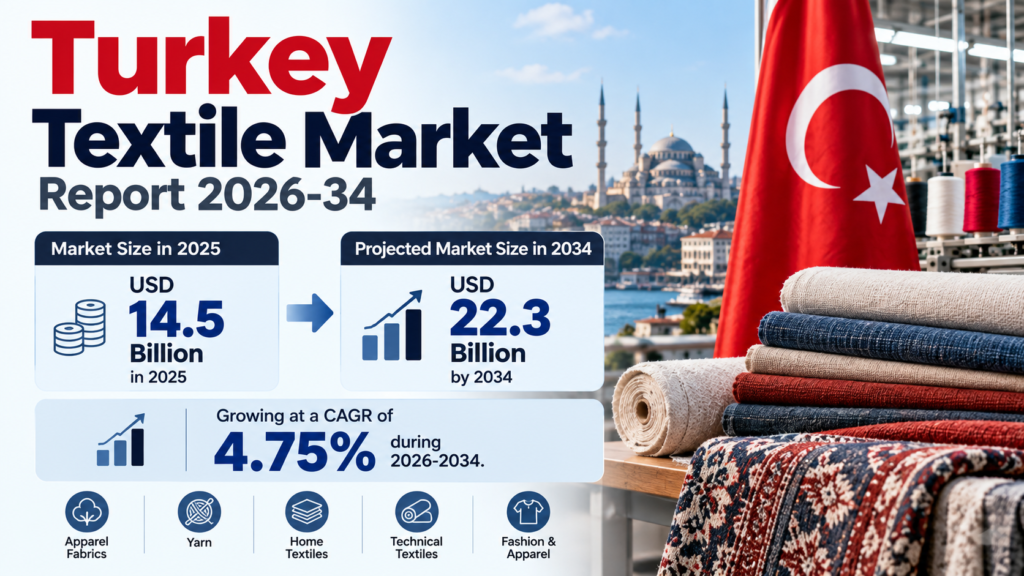
The Turkey textile market has established itself as one of the most significant contributors to the national economy, supported by a rich heritage of craftsmanship, competitive manufacturing costs, and a highly skilled workforce. Turkey textile market size reached USD 14.5 Billion in 2025. Looking forward, IMARC Group expects the market to reach USD 22.3 Billion by 2034, exhibiting a growth rate (CAGR) of 4.75% during 2026-2034, driven by the country’s strategic geographical location that facilitates trade with Europe, the Middle East, and Central Asia, alongside innovative product development, expanding export opportunities, steady government support, and rising global demand for sustainable textiles. Turkey continues to rank among the top global clothing exporters, holding its position as one of the largest suppliers to the European Union’s clothing market.
How AI is Reshaping the Future of Turkey Textile Market?
- AI-Driven Fabric Design and Digital Printing Optimization: Machine learning platforms are enabling Turkish textile manufacturers to generate custom fabric patterns, predict color trends, and optimize digital printing parameters, reducing sample development time and water and chemical usage while allowing shorter production runs tailored to fast-changing fashion and home textile demand.
- Predictive Maintenance and Smart Factory Integration: AI-enabled sensors embedded in weaving, spinning, and dyeing machinery are helping mills across Denizli, Bursa, and Kahramanmaras predict equipment failures before they occur, minimizing downtime and improving overall equipment efficiency in a sector where continuous production runs directly affect export delivery timelines.
- AI-Powered Supply Chain and Export Compliance Management: Textile exporters are deploying AI-based platforms to track raw material sourcing, monitor compliance with European sustainability regulations, and forecast demand from key export destinations, helping manufacturers respond faster to shifting order volumes from global apparel brands and retail buyers.
- Computer Vision for Automated Fabric Inspection: AI-powered visual inspection systems are being installed on production lines to detect weaving defects, dye inconsistencies, and fabric flaws at speeds far exceeding manual inspection, reducing waste and improving the quality consistency that international buyers such as Inditex, H&M, and C&A require from their Turkish suppliers.
Grab a sample PDF of this report: https://www.imarcgroup.com/turkey-textile-market/requestsample
Market Growth Factors
Turkey’s textile industry benefits from a deeply integrated value chain that spans fiber production, spinning, weaving, dyeing, and finished garment manufacturing, all located within relatively short geographical proximity. This vertical integration allows manufacturers to offer faster turnaround times compared to competitors relying on fragmented supply chains across multiple countries. The sector contributes close to 7 percent of the country’s total employment, and textile and ready-made clothing exports have reached figures around USD 32 Billion, reinforcing Turkey’s position as the sixth largest clothing exporter in the world and the third largest supplier to the European Union’s clothing market. Manufacturers such as Akspa Tekstil, producing around 3 million meters of fabric annually for global clients, illustrate the scale at which Turkish textile companies operate to serve international fast fashion and retail brands.
Sustainability has become a defining growth driver as global buyers increasingly demand certified, eco-friendly production. Turkish suppliers are pursuing certifications such as the Global Organic Textile Standard and OEKO-TEX to validate sustainable claims, with pilot programs already certifying Turkish cotton producers under new organic cotton labeling standards. Investments in energy-efficient dyeing, water-saving finishing techniques, and recycled fiber usage are helping manufacturers meet the compliance requirements of the European Union’s environmental regulations, a critical factor given that Europe remains Turkey’s largest textile and apparel export market.
Government backed incentive programs continue to actively shape industry expansion. The Local Development Initiative Incentive Program, introduced by the Ministry of Industry and Technology, extends support across textile manufacturing and textile machinery, including the establishment of fashion design, innovation, and prototyping centers in Istanbul aimed at positioning the city as a global fashion and textile hub. Regional incentive structures also continue to direct new investment toward Eastern and Southeastern Anatolia, where lower regional development status qualifies manufacturers for stronger tax, energy, and employment support, encouraging decentralization of textile manufacturing capacity beyond traditional hubs like Bursa and Istanbul.
Technological modernization is further accelerating the market’s evolution. Digital textile printing adoption is expanding rapidly, with international equipment suppliers showcasing eco-friendly, high precision printing systems at major Istanbul trade fairs to support local manufacturers in reducing water and chemical consumption. Automation in weaving, cutting, and sewing processes is simultaneously improving productivity and product consistency, helping Turkish mills remain price competitive against lower-cost textile producing nations while upholding the quality standards demanded by premium international buyers.
Market Segmentation
Raw Material Insights:
- Cotton
- Chemical
- Wool
- Silk
- Others
Cotton remains the backbone of Turkish textile production, supported by domestic cotton cultivation in regions such as the Southeastern Anatolia Project area, which supplies mills with a steady raw material base and reduces reliance on imported fiber for large segments of yarn and fabric manufacturing.
Product Insights:
- Natural Fibers
- Polyesters
- Nylon
- Others
Natural fibers continue to hold strong demand given Turkey’s established cotton and wool processing base, while polyester production is expanding steadily to serve technical textile applications, activewear, and cost-sensitive segments of the domestic and export apparel market.
Application Insights:
- Household
- Technical
- Fashion and Clothing
- Others
Fashion and clothing applications represent the largest end use category, reflecting Turkey’s dominant position as an apparel manufacturing hub for both domestic retail chains and international fast fashion brands, while technical textiles are gaining momentum through applications in automotive interiors, medical textiles, and industrial fabrics.
Region Insights:
- Marmara
- Central Anatolia
- Mediterranean
- Aegean
- Southeastern Anatolia
- Black Sea
- Eastern Anatolia
Marmara remains the largest regional contributor, anchored by Istanbul and Bursa, which together host the country’s largest concentration of textile mills, garment manufacturers, and export trading houses, while Southeastern Anatolia continues to attract new manufacturing investment through government incentive zones targeting employment generation in less developed provinces.
Turkey Textile Market News
- January 2026: The Aegean Apparel and Garment Exporters’ Association organized Turkey’s national participation with 12 textile and apparel companies at PV Manufacturing New York, aiming to raise annual exports to the United States from USD 1.2 Billion to USD 1.5 Billion through close to 100 planned business meetings with US importers over the two-day fair.
- August 2025: The Ministry of Industry and Technology launched the Local Development Initiative Incentive Program, extending dedicated support to the textile and textile machinery sectors and introducing plans for fashion design, innovation, and prototyping centers in Istanbul to strengthen the city’s global fashion and textile manufacturing profile.
- August 2025: Turkish textile firm KCG Tekstil expanded its operations in Egypt with an additional investment of USD 24 Million, reinforcing Turkiye’s growing footprint in North African manufacturing as companies diversify production capacity to serve European and US buyers more competitively.
- March 2025: At the Texhibition trade fair in Istanbul, which hosted more than 500 exhibitors from 125 countries, industry leaders highlighted that Turkey’s textile and ready-made clothing exports reached approximately USD 32.1 Billion, with the sector generating close to 7 percent of the country’s total employment despite earlier setbacks from earthquake related disruptions.
- March 2024: The Istanbul Apparel Exporters’ Association announced a partnership with the Worldwide Responsible Accredited Production organization as part of a government backed initiative to boost exports to the United States, focused on WRAP certification training to strengthen ethical and sustainable production standards among Turkish manufacturers.
If you require any specific information that is not covered currently within the scope of the report, we will provide the same as a part of the customization.
About Us
IMARC Group is a global management consulting firm that helps the world’s most ambitious changemakers to create a lasting impact. The company provides a comprehensive suite of market entry and expansion services. IMARC offerings include thorough market assessment, feasibility studies, company incorporation assistance, factory setup support, regulatory approvals and licensing navigation, branding, marketing and sales strategies, competitive landscape and benchmarking analyses, pricing and cost research, and procurement research.
Contact Us
IMARC Group,
134 N 4th St. Brooklyn, NY 11249, USA,
Email: sales@imarcgroup.com,
Tel No: (D) +91 120 433 0800,
United States: +1-201-971-6302