How to Choose the Right Custom Software Development Company: A Step by Step Checklist
How to Choose the Right Custom Software Development Company: A Step by Step Checklist
Quick answer
Choosing the right custom software development company comes down to five checks: verify real past work in your industry, confirm how they handle discovery before quoting price, get clarity on team structure and communication, understand pricing and ownership terms in writing, and check how they support the product after launch. Skip any of these and you’re gambling with a budget that usually runs into five figures or more. Below is the full checklist, in order.
Why this decision is harder than it looks
Picking a development partner feels similar to hiring an agency for marketing or design, but the stakes are different. A bad marketing campaign wastes a few thousand dollars and some time. A bad software project can waste $50,000, six months, and leave you with a system your team refuses to use, forcing you to start over with someone else.
The problem is that most of the warning signs don’t show up until month two or three, once you’re already invested. This checklist is built to catch them before you sign anything.
Step 1: Check for real experience, not just a portfolio page
Almost every development company’s website shows polished screenshots and client logos. That tells you very little. What actually matters is whether they’ve built something close to what you need before, and whether they can speak specifically about the problems they solved, not just the technologies they used.
Ask for two or three examples relevant to your industry or workflow type. Then ask a follow up question about a specific challenge in that project (a data migration issue, a scaling problem, an integration that didn’t work as planned). A team with real experience will answer in detail. A team padding its portfolio will get vague fast.
Also check how long the company has been operating and whether their past clients are still using what was built for them. A five year old company with clients still on version one of a five year old product is a strong signal. A company that constantly mentions “rebuilding” past client projects from scratch might be a red flag about how those first projects went.
Step 2: See how they handle discovery before quoting price
This is the single biggest predictor of project success. If a company gives you a fixed price and timeline within a day of your first call, before understanding your workflow, data, or existing systems, that number is a guess. Guesses in software development are almost always wrong, and the gap usually gets filled with change orders and scope creep later.
A company doing this properly will want a discovery phase first, sometimes free, sometimes a small paid engagement, where they map your actual workflow before committing to scope. This is exactly how Custom Software Development Services should start, with the team understanding the problem before proposing the solution, not the other way around.
Ask directly: “How do you scope a project before quoting price?” If the answer is thin, that’s useful information.
Step 3: Understand who actually builds your software
Many development companies sell the project through a senior person and then hand the actual build to a rotating group of contractors you’ll never speak with. That’s not automatically bad, but you need to know it upfront.
Ask who will be on the project day to day, how long they’ve been with the company, and whether the same team stays on your project from start to finish. High turnover mid project is one of the most common reasons custom builds run over budget and over time, because new developers need weeks to understand code they didn’t write.
Also ask how communication works. Weekly updates, a shared project board, direct access to the developers, or only updates through a single account manager who relays everything secondhand? The second option adds delay and loses detail every time.
Step 4: Get pricing and ownership terms in writing before starting
Vague pricing is the most common source of disputes in custom software projects. Before agreeing to anything, get clear answers on four things in writing.
First, is the pricing fixed, time and materials, or a hybrid, and what happens if scope changes mid project. Second, what exactly is included in that price (design, development, testing, and how many rounds of revisions). Third, who owns the code and intellectual property once the project is complete, this should be explicit, not assumed. Fourth, what happens if the relationship ends early, do you get access to the code as it stands, or does the process stall.
None of this is unusual to ask for. A legitimate company will have these answers ready and documented. Hesitation here is worth paying attention to.
Step 5: Check what happens after launch
A shocking number of custom software relationships end the day the product ships, which is exactly when real usage starts revealing bugs, edge cases, and small workflow mismatches that only show up once employees are actually using the system daily.
Ask what post launch support looks like specifically. Is there a warranty period for fixing bugs found after launch. Is ongoing maintenance a separate contract, and roughly what does that run annually. Who do you call if something breaks on a Friday afternoon. A company without a clear answer here is planning to disappear after the invoice clears.
This step matters even more if what you’re building has ambitious growth plans. If the long term goal is turning an internal tool into something you sell to other businesses, you want a partner who understands that path from day one rather than one who has to relearn the architecture later. SaaS Development Services require different decisions around multi tenancy, billing, and security than a purely internal tool, and a company without that experience will likely need to rebuild large parts of the system if you pivot toward selling it later.
A shortened version of the checklist
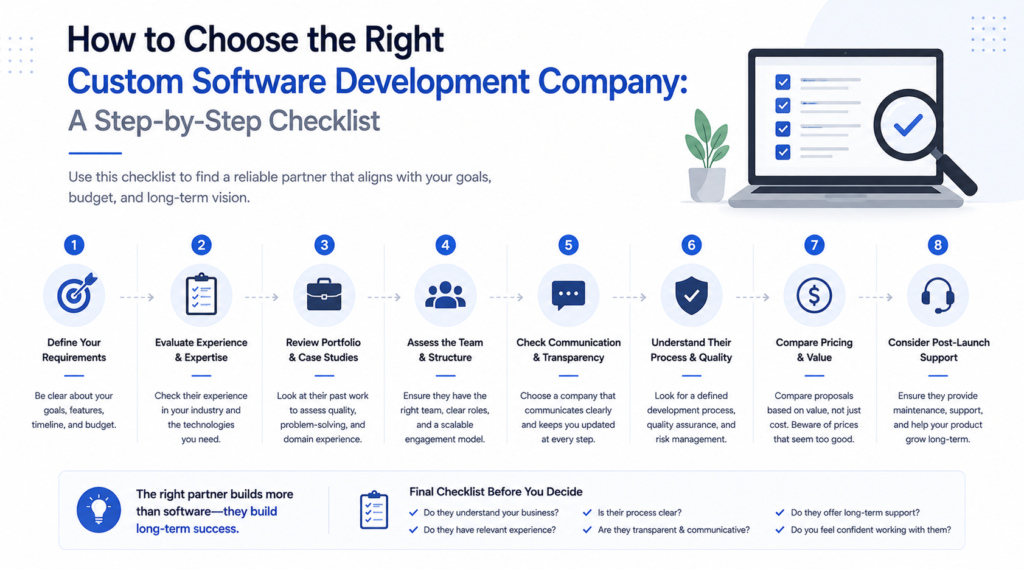
Before signing with any development company, confirm you have real answers, not marketing language, on these points:
- Relevant past projects with specific details, not just logos
- A discovery process that happens before pricing, not after
- A named team that stays consistent through the project
- Written terms on pricing, scope changes, and code ownership
- A clear plan for support and maintenance after launch
- References you can actually contact, not just quotes on a website
If a company checks all six honestly, you’ve likely found a partner worth trusting with real budget. North Rose Technologies follows this exact structure, starting with discovery and staying involved well past launch, which is the model worth looking for regardless of who you end up choosing.
FAQs
What questions should I ask a custom software development company before hiring them? Ask about relevant past experience in detail, how they scope projects before quoting price, who specifically will build your software and whether that team stays consistent, what’s included in the price, who owns the code, and what support looks like after launch.
How much does it cost to hire a custom software development company? Costs vary by scope, but a focused tool typically runs $15,000 to $50,000, while a full platform can run well past $150,000. Be cautious of any company quoting a fixed price before understanding your workflow in detail.
Should I choose a local company or a remote development team? Location matters less than communication quality and time zone overlap. A remote team with clear processes and consistent updates often outperforms a local team with poor project management, so evaluate the process, not the address.
How long should the discovery phase take before development starts? This depends on project size, but expect anywhere from one to four weeks for a mid sized project. A discovery phase that takes a single call is usually too short to produce an accurate scope or price.
What’s a red flag when evaluating a development company? Fixed pricing given before any discovery conversation, vague answers about who will actually build the software, no clear terms on code ownership, and no mention of what happens after launch are the most common warning signs.
Do I own the source code after the project is completed? In most legitimate agreements, yes, but this must be stated explicitly in the contract. Never assume ownership terms, confirm them in writing before development begins.