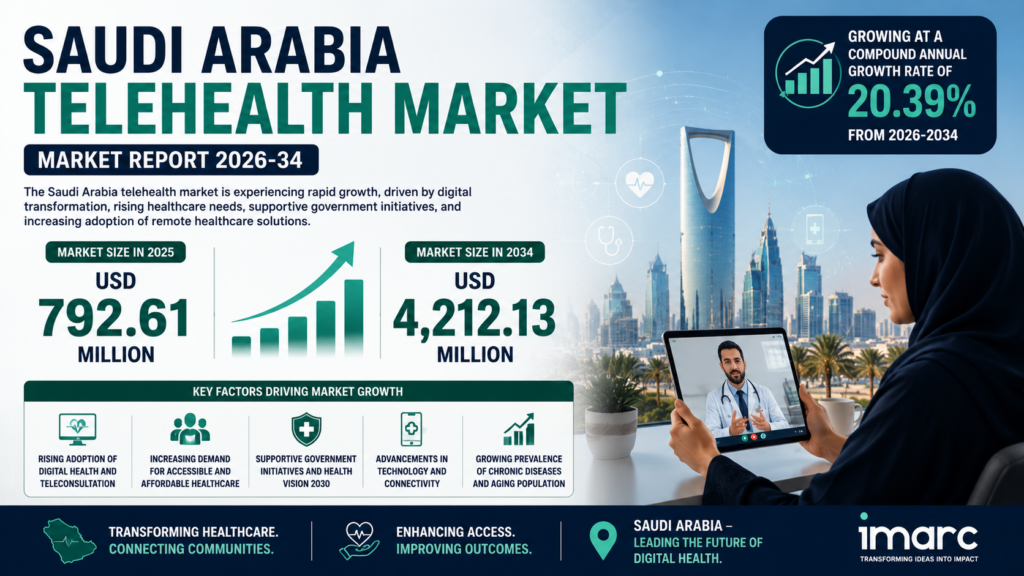
The Saudi Arabia Telehealth Market is experiencing strong expansion as the Kingdom accelerates healthcare digitalization under Vision 2030. Growing adoption of virtual consultations, remote patient monitoring, digital diagnostics, and connected healthcare platforms is improving access to medical services while helping healthcare providers extend specialist care beyond traditional facilities. Saudi Arabia telehealth market size was valued at USD 792.61 Million in 2025 and is projected to reach USD 4,212.13 Million by 2034, growing at a compound annual growth rate of 20.39% from 2026-2034.
Government investment in digital healthcare infrastructure is a major market catalyst. Seha Virtual Hospital has connected 241 hospitals and more than 1,400 health centers, providing access to specialized medical expertise remotely across the Kingdom. The platform also supports services across 114 primary and subspecialty areas, strengthening the integration of virtual care into the national healthcare ecosystem.
Rising chronic disease prevalence is further creating demand for telehealth services, particularly for continuous monitoring, follow-up consultations, behavioral healthcare, cardiology, diabetes management, and other long-term care requirements. Saudi Arabia’s Universal Health Coverage Index score reached 83 points, reflecting improvements in healthcare access and coverage.
How AI is Reshaping the Future of Saudi Arabia Telehealth Market?
- AI-powered telehealth platforms are enabling healthcare providers to analyze patient information, identify potential health risks, support clinical decision-making, and personalize remote consultations. AI is increasingly being integrated into digital healthcare systems to improve diagnostic efficiency and care coordination.
- AI-enabled remote monitoring is expanding the capabilities of telehealth beyond video consultations. Wearable devices, connected medical equipment, and intelligent monitoring systems can continuously collect patient information and support earlier intervention for chronic conditions.
- Saudi Arabia is also strengthening the regulatory environment for AI-powered healthcare technologies. The Saudi Food and Drug Authority granted marketing authorization to an AI-powered medical application capable of measuring heart rate, oxygen saturation, and blood pressure through smartphone cameras. The technology uses remote photoplethysmography and underwent clinical evaluation in Saudi Arabia before authorization.
- AI-powered platforms can also improve healthcare resource allocation by identifying demand patterns, optimizing appointment scheduling, supporting triage, and connecting patients with appropriate specialists. This is particularly valuable for a healthcare system seeking to improve access across urban centers and remote communities.
- AI is additionally supporting virtual mental healthcare, chronic disease management, telecardiology, teleradiology, and remote diagnostics. The Ministry of Health reported that Seha Virtual Hospital delivered more than 54,000 virtual addiction consultations, with 2,468 individuals starting treatment and an 80% adherence rate, demonstrating the potential of confidential digital healthcare pathways.
Grab a sample PDF of this report: https://www.imarcgroup.com/saudi-arabia-telehealth-market/requestsample
Market Growth Factors
The Saudi Arabia telehealth market is being driven by government-led healthcare transformation, expanding digital infrastructure, growing patient acceptance of remote consultations, and increasing demand for convenient access to specialized medical services. The Ministry of Health identifies telemedicine as an important component of its national e-health strategy, supporting remote diagnosis, examination, medical assessment, professional consultation, and healthcare communication.
The expansion of Seha Virtual Hospital is significantly strengthening the country’s telehealth ecosystem. More than 16 million virtual appointments and medical consultations have been delivered through the platform, including more than 11.5 million completed virtual clinic appointments. The network has also managed more than 220,000 clinical cases, demonstrating the scalability of virtual healthcare delivery.
Government digital-health initiatives are also improving accessibility for patients who face geographic or mobility-related barriers. The Health Sector Transformation Program is promoting integrated healthcare delivery, digital connectivity, and patient-centered services, while the national e-health strategy aims to facilitate access to healthcare information and remote consultations.
Chronic disease management represents another important opportunity. Telehealth enables patients to receive regular follow-ups, medication guidance, remote monitoring, and specialist consultations without requiring frequent hospital visits. This model is particularly relevant to diabetes, cardiovascular diseases, hypertension, obesity, mental health conditions, and other chronic illnesses.
Healthcare providers are increasingly combining physical and virtual care models. Digital consultations can handle follow-ups, preliminary assessments, specialist opinions, and monitoring, while physical facilities remain available for procedures, imaging, emergency treatment, and complex diagnoses. This hybrid model can improve healthcare efficiency while increasing patient convenience.
Market Segmentation
Component Insights:
- Software
- Hardware
- Services
Communication Technology Insights:
- Video Conferencing
- mHealth Solutions
- Other Communication Technologies
Hosting Type Insights:
- Cloud-Based and Web-Based
- On-Premises
Application Insights:
- Teleconsultation and Telementoring
- Medical Education and Training
- Teleradiology
- Telecardiology
- Tele-ICU
- Tele-Psychiatry
- Tele-Dermatology
- Other Applications
End User Insights:
- Providers
- Patients
- Payers
- Others
Regional Insights:
- Northern and Central Region
- Western Region
- Eastern Region
- Southern Region
Recent Development & News
- April 2024: Saudi Arabia continued expanding digital healthcare capabilities through national e-health initiatives focused on remote care, electronic health records, healthcare connectivity, and improved access to medical services. The national e-health strategy emphasizes personalized healthcare access, remote consultations, clinical decision support, and integrated health information systems.
- June 2025: The Ministry of Health announced that Seha Virtual Hospital had provided more than 54,000 virtual addiction-treatment consultations, with 2,468 individuals beginning treatment and an 80% adherence rate, highlighting the application of telehealth in confidential behavioral and addiction care.
- May 2025: Seha Virtual Hospital launched round-the-clock virtual medical consultations for Hajj pilgrims through the unified 937 call center, Sehhaty application, and X platform. Services were made available in seven languages, including Arabic, English, French, Turkish, Persian, Urdu, and Indonesian.
- October 2025: The Ministry of Health’s Global Health Exhibition showcased digital healthcare innovations through Seha Virtual Hospital, including virtual consultations, geriatric medicine services, and a virtual obesity clinic supporting integrated remote care.
- October 2025: The Digital Health Forum in Riyadh emphasized telemedicine, hybrid care, wearable technologies, remote chronic-disease management, and AI-supported early intervention as key components of Saudi Arabia’s digital healthcare transformation.
- January 2026: Seha Virtual Hospital reported more than 16 million virtual appointments and medical consultations, including over 5 million completed virtual clinic appointments and more than 220,000 clinical cases managed, demonstrating the growing scale of virtual healthcare delivery.
- June 2026: The Saudi Food and Drug Authority authorized an AI-powered medical application capable of measuring heart rate, oxygen saturation, and blood pressure through smartphone cameras. The technology was evaluated through the SFDA Regulatory Sandbox and a clinical trial conducted in Saudi Arabia.
- June 2026: The Health Sector Transformation Program reported that more than 31 million users had benefited from the Sehhaty application, while Seha Virtual Hospital had expanded services to more than 365,000 beneficiaries through a network of 241 connected healthcare facilities.
- August 2026: Saudi Arabia’s Ministry of Health highlighted Seha Virtual Hospital’s connection with 241 hospitals and more than 1,400 health centers, with virtual services covering 114 primary and subspecialty areas. The development further demonstrates the Kingdom’s focus on using digital technologies and AI to expand healthcare access.
If you require any specific information that is not covered currently within the scope of the report, we will provide the same as a part of the customization.
About Us
IMARC Group is a global management consulting firm that helps the world’s most ambitious changemakers to create a lasting impact. The company provides a comprehensive suite of market entry and expansion services. IMARC offerings include thorough market assessment, feasibility studies, company incorporation assistance, factory setup support, regulatory approvals and licensing navigation, branding, marketing and sales strategies, competitive landscape and benchmarking analyses, pricing and cost research, and procurement research.
Contact Us
IMARC Group,
134 N 4th St. Brooklyn, NY 11249, USA,
Email: sales@imarcgroup.com,
Tel No: (D) +91 120 433 0800,
United States: +1-201971-6302