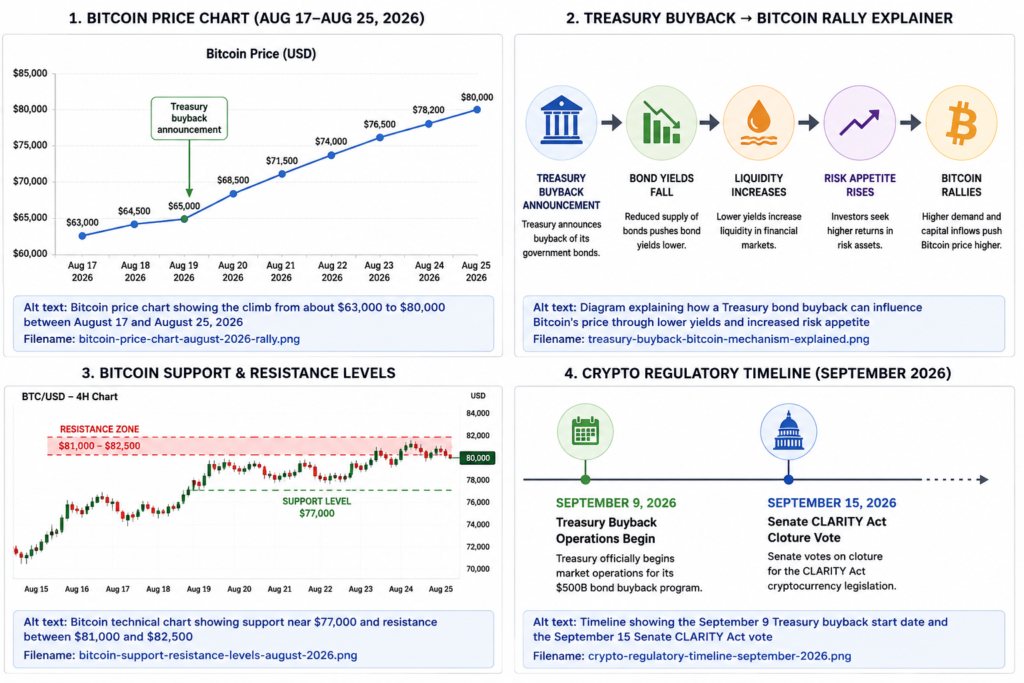
Why is Bitcoin up today? Treasury moves, ETF inflows and short liquidations helped drive Bitcoin toward $80,000.
Bitcoin’s reclaiming of $80,000 — its highest level in more than three months — driven by a US Treasury bond buyback expansion, the largest weekly Bitcoin ETF inflow since October 2025, and a short squeeze, with a September 15 Senate vote on crypto market-structure legislation adding a forward-looking angle.
Why is Bitcoin up today? Bitcoin climbed back above $80,000 on Tuesday, reaching its highest level since mid-May after a powerful week-long rally. The move has been fueled by a combination of strong spot Bitcoin ETF inflows, changes in the US Treasury bond market, and a short squeeze that forced bearish traders to close their positions.
Bitcoin was trading near $80,300 on Tuesday afternoon after briefly moving above $81,000. With several forces pushing BTC higher at the same time, understanding what is driving the rally matters more than simply watching the price.
The rally isn’t coming from a single crypto-specific headline. A US Treasury bond buyback expansion, strong spot Bitcoin ETF inflows, and a short squeeze have combined to push Bitcoin higher
Bitcoin climbed back above $80,000 on Tuesday for the first time since mid-May, capping a rally of roughly 25% in seven days that several outlets, including CNBC, have called the cryptocurrency’s strongest three-day run since 2023. As of Tuesday afternoon, Bitcoin was trading near $80,300, having briefly touched above $81,000 before pulling back — a reminder that at this pace, any price quoted here can shift within the hour.
The move isn’t coming from a single crypto-specific headline. It’s the product of three things landing in the same week: a US Treasury Department decision that reshaped bond markets, a wave of institutional money returning to Bitcoin ETFs, and a short squeeze that forced traders betting against Bitcoin to buy back in at a loss.
For anyone asking why is Bitcoin up today, ETF demand alone doesn’t tell the full story. The Treasury move and resulting short squeeze also played important roles in accelerating BTC’s rally.
Why Is Bitcoin Up Today? 3 Factors Driving the Rally
- The Treasury doubled its bond buyback program.
On Aug. 19, Treasury Secretary Scott Bessent announced the department would at least double the size of its long-end bond buyback operations — from a $2 billion cap to at least $4 billion per operation — covering 10-to-20-year and 20-to-30-year Treasury securities. The change takes effect Sept. 9 and runs through the Nov. 4 refunding quarter.
If that sounds like it has nothing to do with Bitcoin, that reaction is fair — and it’s exactly what most coverage of this story skips over.
Here’s the plain-language version:
The Treasury has run a standing buyback program since May 2024, regularly repurchasing older bonds from the market to keep the bond market functioning smoothly. Doubling the size of that program means the government is pulling more long-dated debt out of circulation and effectively pumping more short-term liquidity into the financial system. That tends to push bond yields down — and it did: the 30-year Treasury yield fell from a 19-year high near 5.34% to about 5.19% within hours of the announcement.
When yields fall and liquidity increases, investors typically become more willing to hold riskier assets, because safer alternatives like bonds are paying less. Bitcoin, as one of the more volatile assets institutional money can access, tends to see outsized moves when that “risk-on” shift happens quickly. That’s the mechanism — not a direct link between Treasury policy and crypto, but a liquidity and risk-appetite shift that spilled into Bitcoin.
Treasury framed the move as a response to “consistent strong sponsorship” from bond dealers, meaning dealers were offering more bonds into existing buyback operations than the government was purchasing — suggesting room to buy more without straining the program.
- Bitcoin ETFs just posted their best week in about ten months.
US spot Bitcoin ETFs recorded roughly $1.92 billion in net inflows for the week ending Aug. 21, according to SoSoValue data reported by multiple outlets — the strongest weekly haul since October 2025. BlackRock’s IBIT led with about $1.33 billion of that total. Spot Ethereum ETFs added close to $700 million over the same stretch, giving the two categories a combined $2.6 billion week, also their best since October 2025.
That’s a meaningful reversal: US spot Bitcoin ETFs are still down roughly $2.9 billion in net outflows for 2026 overall, but August alone has brought in about $2.38 billion, making it the strongest inflow month of the year so far.
- A short squeeze amplified the move.
Heading into the Treasury announcement, a large number of traders were positioned for Bitcoin to stay below $67,000. When price broke that level, exchanges began force-closing those losing bets automatically — and each forced buy order pushed the price higher, triggering more liquidations in a feedback loop. Reported figures for the initial squeeze vary by outlet and measurement window, ranging from roughly $1.4 billion to $3 billion in liquidated short positions over the days following Aug. 19; the wide range partly reflects different reporting periods (a single hour versus a full 24 hours) rather than a factual disagreement. A separate, smaller liquidation wave — about $400 million total, including roughly $160 million in Bitcoin shorts — accompanied Tuesday’s push toward $80,000.
The Regulatory Backdrop: What’s the CLARITY Act, and Does It Matter Here?
Bitcoin’s rally has coincided with renewed momentum for the Digital Asset Market Clarity Act (CLARITY Act), a bill that would create a formal legal framework for cryptocurrency markets in the US, primarily by dividing regulatory jurisdiction between the SEC and the CFTC. On Aug. 19 — the same day as the Treasury announcement — President Trump met with regulators and exchange executives at the White House to push for the bill’s passage.
The Senate has scheduled a procedural cloture vote for Tuesday, Sept. 15, which requires 60 votes to move the bill toward formal debate. It’s worth being precise about what this vote is and isn’t: it is not a final passage vote. It’s the first procedural hurdle, and lawmakers still haven’t resolved disputes over ethics provisions — Sen.
Elizabeth Warren has specifically raised concerns given the Trump family’s own crypto business ties. Prediction markets have reflected that uncertainty: one tracked market priced the odds of CLARITY becoming law in 2026 at around 24.5% as of this research, down from 28% a day earlier but up from 18% a week prior. Coinbase CEO Brian Armstrong has publicly said he expects the bill to pass; that is his stated opinion, not a market certainty.
Where Bitcoin Stands Technically Right Now
By multiple technical readings gathered Tuesday, Bitcoin’s rally has pushed deep into overbought territory. The 14-day Relative Strength Index (RSI) — a momentum indicator where readings above 70 are generally considered overbought — has been reported in the low-to-mid 80s across several analyses Tuesday, among the highest readings Bitcoin has produced this year. An overbought RSI doesn’t mean a reversal is guaranteed; it means the market has moved further and faster than recent trading would typically support, and further gains from here likely need fresh buying interest rather than pure momentum.
Support and resistance, per Tuesday’s technical readings:
| Level | Approximate Range | Why It Matters |
| Immediate resistance | $81,000–$82,500 | Includes Tuesday’s intraday high near $81,255 |
| Next resistance if broken | $83,000+ | Could invite further short liquidations |
| Nearest support | $76,500–$77,400 | Recent consolidation zone before Tuesday’s push |
| Deeper support | $74,000 | Would signal the rally is losing structural strength |
What could happen from here (scenarios, not predictions):
- Bull case: A daily close above resistance near $82,500 on strong volume would be a genuine breakout signal, opening the path toward levels analysts have floated near $89,000 — though that figure comes from chart-pattern extrapolation, not a fundamental valuation.
- Base case: Bitcoin consolidates in the high-$70,000s to low-$80,000s while the market digests the move and waits for the Sept. 9 buyback operations and Sept. 15 Senate vote.
- Bear case: A failure to hold above roughly $77,000 support could expose a pullback toward the $69,000–$74,000 zone, which would still leave Bitcoin well above where it traded before Aug. 19.
External Sources Used
- Bloomingbit — “US Spot-Bitcoin ETFs Draw $1.92 Billion in Weekly Inflows, Most Since October 2025” (Aug. 24, 2026)
- Coinotag — “US Bitcoin (BTC) Spot ETFs Log $1.9B Weekly Inflows, Strongest Since October” (Aug. 25, 2026)
- KuCoin News (citing SoSoValue/Farside data) — Bitcoin ETF flow flash reports (Aug. 21–22, 2026)
- Forbes — “Bitcoin Approaches $70,000 After Treasury Announces Buyback Expansion” (Aug. 19, 2026)
- Bit.com — “Bitcoin Hit $70K on a Treasury Buyback. Here’s the Mechanism” (Aug. 2026)
- Crypto.news — “The Treasury buyback trade: how $4 billion in bond operations moved Bitcoin 8% in a day” (Aug. 2026)
- Cryptonomist — Bitcoin price analysis updates (Aug. 24–25, 2026)
- Invezz — “Bitcoin rockets past $80K but one technical warning could spoil the breakout” (Aug. 25, 2026)
- TradingKey — “Bitcoin Surges Over 3% to Touch $80,000” (Aug. 25, 2026)
- Yahoo/Reuters-sourced coverage — “Senate Keeps Clarity Act Alive With Crypto Bill Vote Set for September”
- Latham & Watkins US Crypto Policy Tracker — Legislative Developments (updated Aug. 2026)
- Disruption Banking — “CLARITY Act News: The Crypto Bill Just Slipped to a September 15 Senate Showdown”
- CryptoBriefing — “Senate to vote on Clarity Act Sept. 15, key step for crypto regulation”
- Cryptonews.com — “Bitcoin Price Analysis: Can BTC Clear $80K This Week?” (competitor reference, Aug. 24, 2026)