Construction operates on razor-thin margins. Every hour a machine sits idle, revenue disappears. If you run Kobelco cranes, you already appreciate their dependability on the job. Even the most robust equipment, though, requires routine maintenance. And eventually, components fail.
The purchasing strategy you follow for replacements has a direct effect on your bottom line. Most contractors buy parts individually, responding to each breakdown as it happens. On the surface, this seems financially prudent — you spend only when something breaks.
Yet this reactive approach quietly drains your budget. Buying in volume reverses the trend. It reduces per-unit costs, minimizes downtime, and keeps projects on schedule. Below, we examine how bulk purchasing creates measurable advantages for your operation.
Understanding the True Cost of Downtime
When a crane goes offline, the financial bleeding begins immediately. Your operator sits idle but still earns wages. The surrounding crew has no lift to work around. Deadlines that were already tight begin to slip further.
You contact your supplier and place an order. Rush shipping is the only option if you need the part quickly, and that premium adds up fast. If the supplier has no stock, the delay stretches even longer. The component’s price tag represents just a fraction of the real cost.
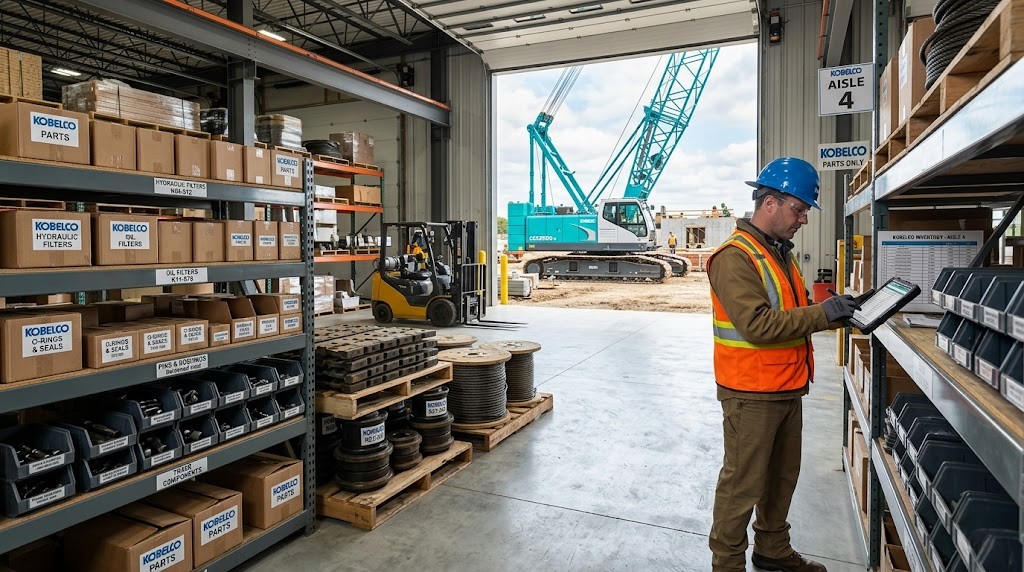
Maintaining an inventory of critical crane parts on-site fundamentally alters this scenario. When failure occurs, your technician retrieves a spare from the shelf and installs it. Work resumes within minutes. No expedited freight. No crew standing around with nothing to do.
Slashing Freight and Handling Costs
Heavy machinery components are expensive to ship. Every individual order carries its own freight surcharge, handling fee, and processing overhead.
Consider a typical month without bulk planning. You order hydraulic seals early in the week. Days later, a filter set needs to ship. Then bushings and pins follow in yet another package. Each transaction incurs separate delivery charges. Those fees accumulate faster than most contractors realize.
Consolidation solves the problem. When you purchase Kobelco parts in meaningful quantities, individual shipments merge into one. You pay freight once. Many suppliers remove shipping charges entirely once your order crosses a specific dollar threshold. Bulk buying makes that target effortless to reach.
Shielding Operations from Supply Chain Disruptions
Supply chains worldwide remain fragile. Delivery timelines that once seemed reliable have stretched unpredictably. Port backlogs, production slowdowns, and material shortages can surface with little notice.
If you wait until a failure forces your hand, you become subject to whatever delays exist in the system. Building an inventory of essential components acts as a buffer against these disruptions. You no longer depend on next-day delivery to resume operations.
When a supplier exhausts its stock of specific Kobelco parts, your business does not pause. The items you need already sit in your own storage area. Your crew keeps working while competing contractors wait for backorders to clear.
Capturing Better Unit Pricing
Suppliers prefer predictability in their sales pipeline. Consistent, large-volume orders signal a committed customer. That reliability earns you leverage during negotiations.
Many distributors structure their pricing in tiers. Higher quantities unlock lower per-unit rates. This is particularly valuable for high-turnover items like filters, seals, and wear plates. If your fleet burns through a predictable number of crane parts every quarter, buying the entire batch at once generates savings on every unit.
Volume purchasing also provides a buffer against future price increases. If the manufacturer raises list prices next month, you have already acquired your supply at the current rate. The difference between what you paid and what others will pay represents real, tangible savings.
Streamlining Your Administrative Workflow
Trace the steps behind a single parts purchase. A technician flags the need. A foreman signs off. Procurement prepares a purchase order. The supplier generates an invoice. Your accounting team processes payment.
Repeat that cycle ten or fifteen times per month and the labor hours add up considerably. Consolidating into bulk orders collapses the entire workflow into a single transaction per cycle. One request. One approval. One purchase order. One invoice.
Your office staff redirects those reclaimed hours toward tasks that directly support project delivery. Administrative overhead eats into profits just as destructively as equipment downtime. Fewer individual transactions also mean fewer opportunities for clerical errors and payment disputes.
Choosing Which Items Deserve Bulk Investment
Not everything belongs in a bulk order. Purchasing major assemblies — engines, transmissions, booms — in large quantities makes sense only for companies running extensive fleets of the same model.
For the majority of construction firms, bulk purchasing should concentrate on consumables and regularly replaced wear items. These components cycle through your maintenance schedule on a predictable basis:
- Filtration (engine oil, hydraulic fluid, air intake)
- Brake pads and discs
- Pivot pins and bushings
- Wire rope and hoist cables
- Hydraulic seals and O-rings
- Crawler undercarriage pieces (track shoes, rollers, idlers)
These items will be consumed over each crane’s operational life. They store safely without deterioration. Map out the service intervals for every unit in your fleet. Cross-reference which Kobelco parts appear most frequently in routine maintenance records. Prioritize those entries for your next bulk purchase.
Making Inventory Control Actually Work
Buying in volume only pays dividends if you manage storage and tracking with discipline. Purchasing a case of filters and leaving them in an uncontrolled environment invites moisture damage and degradation. Ruined stock negates any savings you gained.
area for parts storage. Log every item that enters and leaves the space. Follow a first-in, first-out rotation — new deliveries go behind older stock on the shelf. This ensures the oldest inventory gets used before anything agesYou need a straightforward system. Designate a clean, dry past its prime.
Expensive tracking software is not a prerequisite. A well-maintained spreadsheet and organized shelving accomplish the same goal. The measure of success is simple: a technician should locate any stored component within moments of needing it.
Strengthening Your Supplier Relationship
Purchasing at scale shifts how vendors perceive your account. You move from infrequent, transactional orders to a steady, predictable relationship. Suppliers naturally invest more attention in their most consistent customers.
Need a technical specification on short notice? You are far more likely to receive a prompt response. Looking for an item that is difficult to source? A strong account means your request gets priority when hard-to-find crane parts become available. These advantages take time to develop, but placing bulk orders is the most direct path to building them.
Transitioning from Reactive Habits to Proactive Planning
Ordering replacements one at a time is, by nature, a reactive posture. Something fails, and you respond after the fact. The cycle creates stress and inflates costs.
Bulk purchasing forces a different discipline. You examine your maintenance calendar well in advance. You allocate budget proactively rather than scrambling to cover emergency expenses. You identify needs before they become urgent.
This mental shift extends beyond individual components. It reshapes how your entire fleet is managed. Proactive maintenance catches deterioration in its early stages. Catastrophic failures become less frequent. Crane longevity increases. When you have the right items on hand, technicians follow through on scheduled service without delays caused by missing stock. Routine care happens on time, preventing the major breakdowns that derail budgets and timelines.
Bringing It All Together
Managing a construction business demands constant cost discipline. Purchasing replacements individually may feel like the cautious choice, yet it silently taxes your operation in several ways simultaneously.
Freight fees multiply across every small order. The penalty is amplified with higher-value components, so the savings on Kobelco parts alone can be substantial when buying in bulk. Paperwork multiplies. And every hour a crane waits represents revenue you cannot recover.
A bulk procurement strategy addresses each of these pressures at the same time. Unit costs decrease. Freight consolidates into fewer, cheaper deliveries. Supply chain uncertainty stops dictating your schedule. The approach requires planning and available capital, but the returns are consistent and compounding. Your equipment operates more hours each week. Your crews remain engaged and productive. And your financial position strengthens with each successive project.