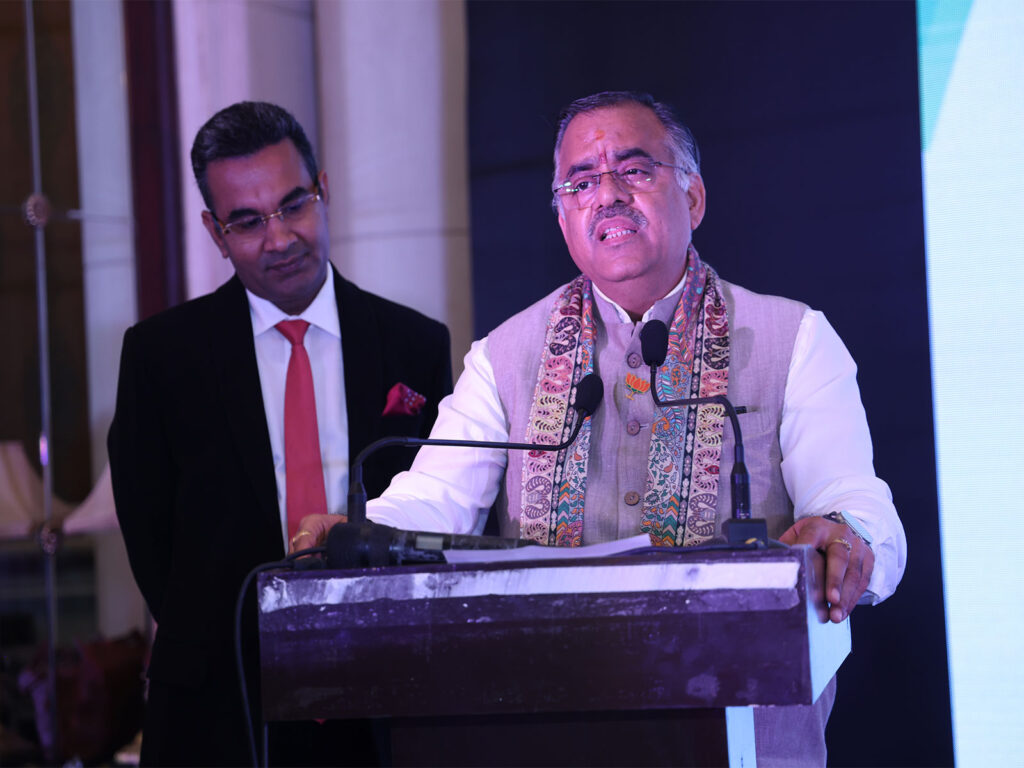
India’s push toward technology-driven rural development took center stage recently at the National Drone Summit 2026, where Shri Tarun Chugh, National General Secretary of the Bharatiya Janata Party (BJP) and Member of Parliament (Rajya Sabha), addressed the gathering as Chief Guest. In his address, Chugh spoke about the transformative role drones can play in reshaping the lives of rural India, its farmers, and its youth, marking the summit as an important platform for discussing the future of agri-tech and rural innovation.
Chugh opened his remarks by placing India’s progress in a global context, noting that the country today stands as a strong global power. He emphasized that drones have moved far beyond being just another modern gadget — they have become a genuine tool for change, capable of making agriculture more scientific, strengthening the rural economy, and generating fresh opportunities for the nation’s young population. This framing set the tone for the rest of the National Drone Summit 2026, where much of the discussion centered on practical applications of drone technology in everyday rural life.
A central theme of Chugh’s address was that development only achieves its true purpose when the benefits of modern technology reach every village, not just urban centers or large commercial farms. According to him, one of the most promising applications of drones lies in agriculture, where they can support crop monitoring, enable precision spraying of fertilisers and pesticides, and significantly cut down operational costs for farmers. These capabilities directly address long-standing challenges in Indian farming, such as inefficient resource use, rising input costs, and the labour-intensive nature of traditional spraying methods.
Chugh explained that these advancements are expected to improve agricultural productivity while enabling farmers to make better use of limited resources like water, fertiliser, and labour. By reducing waste and improving accuracy in the field, drone-assisted farming can help make agriculture more modern, efficient, and ultimately more profitable for smallholder and marginal farmers alike — a group that makes up a large share of India’s agricultural workforce.
Beyond agriculture, the National Drone Summit 2026 also highlighted the role drones can play in empowering India’s youth. Chugh described young Indians as the country’s greatest strength, stressing that skill development and specialised training in drone technology can unlock new avenues for both employment and self-employment. As drone adoption grows across sectors like farming, surveying, logistics, and infrastructure inspection, the demand for trained drone pilots and technicians is expected to rise, creating a fresh employment pipeline for millions of young people, particularly in rural and semi-urban areas where job opportunities have traditionally been limited.
Chugh added that technology only becomes truly meaningful when it empowers people to become self-reliant and brings positive, tangible change to their everyday lives. This people-centered view of technology adoption reflects a broader shift in how policymakers are approaching innovation — not simply as an economic metric, but as a tool for social upliftment and individual empowerment.
Another key point raised during the summit was the idea of blending India’s long-standing cooperative traditions with advanced technology. Chugh noted that cooperation has historically been a strong foundation of India’s development journey, and that the time has now come to integrate this cooperative spirit with modern technological tools like drones. This combination, he suggested, could help scale the benefits of drone technology beyond individual farmers to entire farming communities, cooperatives, and Farmer Producer Organisations (FPOs), amplifying its impact at the grassroots level.
The National Drone Summit 2026 arrives at a time when drone-based solutions are already gaining traction across rural India through government schemes, agri-tech startups, and skilling initiatives. Discussions at such summits are increasingly shaping policy direction and industry investment, as stakeholders from government, industry, and academia come together to explore how emerging technologies can be scaled responsibly and inclusively.
Overall, Chugh’s address at the National Drone Summit 2026 reinforced a clear message: drone technology is not just an urban or industrial innovation, but a tool with the potential to reach every village, support every farmer, and create opportunities for every young Indian willing to learn and adapt. As India continues to invest in rural technology adoption, summits like this one play a crucial role in bridging the gap between innovation and implementation, ensuring that the promise of drone technology translates into real, on-the-ground impact for the country’s agricultural and youth-driven economy