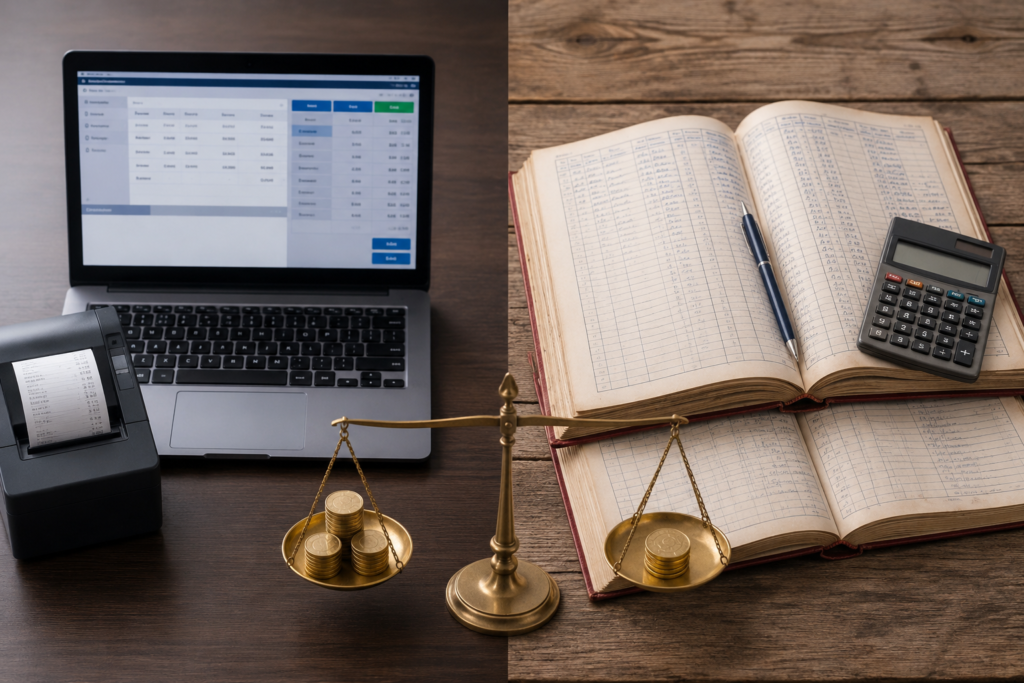
Introduction
Every retail shop owner eventually faces the same quiet debate: stick with the familiar ledger book that’s worked for years, or invest in billing software that promises speed and accuracy. On the surface, the ledger feels free, it’s just paper and a pen, no subscription, no learning curve. Billing software, on the other hand, comes with an upfront or monthly cost that can feel like an unnecessary expense, especially for a small shop watching every rupee.
But here’s the thing about cost: it’s rarely just about the price tag. A manual ledger has hidden costs that don’t show up on any invoice, lost time, calculation errors, missed tax deadlines, and stock you didn’t know you’d run out of. Billing software has costs too, but it also delivers measurable returns that are easy to overlook until you actually run the numbers.
This article breaks down both options honestly, what they cost, what they save, and what actually makes financial sense for a growing shop, whether you’re running a single counter in a small town or managing multiple outlets.
Understanding the Real Cost of a Manual Ledger
A manual ledger looks inexpensive because the only visible cost is a notebook. But running a shop this way comes with operational costs that accumulate quietly over time.
Time Cost
Every bill written by hand, every total calculated manually, and every entry copied into a register takes time. Multiply that across dozens or hundreds of daily transactions, and you’re looking at hours each week spent on tasks that contribute nothing to actually growing your business.
Error Cost
Manual calculations are vulnerable to human mistakes. A wrong total, a missed discount, or a duplicate entry might seem small individually, but across a month, these errors can mean real money lost, either through undercharging customers or through inventory and cash mismatches that are hard to trace back.
Compliance Cost
In India, GST requires itemized, accurate records with correct tax rates and HSN codes. Recreating this from a handwritten ledger at filing time often means paying an accountant extra hours just to organize and verify your data, an indirect cost that’s easy to underestimate.
Opportunity Cost
Perhaps the biggest hidden cost is what you’re not doing while you’re stuck reconciling a ledger: serving customers faster, analyzing sales trends, or planning your next stock order. Time spent on manual bookkeeping is time taken directly from growing the business.
Understanding the Real Cost of Billing Software
Billing software has a visible price tag, whether it’s a one-time license fee or a monthly subscription. This upfront cost is exactly why many shop owners hesitate. But it’s worth examining what that cost actually buys.
| Cost Type | Manual Ledger | Billing Software |
| Upfront cost | Minimal (notebook) | License fee or subscription |
| Ongoing cost | Stationery, accountant hours | Subscription/maintenance fee |
| Time cost | High (manual entry, reconciliation) | Low (automated calculations) |
| Error-related losses | Frequent, hard to trace | Rare, system-validated |
| Tax filing cost | High (manual data prep) | Low (auto-generated reports) |
| Scalability cost | Increases sharply with growth | Minimal additional cost per outlet |
The software cost is fixed and predictable. The ledger’s hidden costs, by contrast, tend to grow as your shop grows, which is exactly when they become hardest to ignore.
Benefits That Go Beyond Cost Savings
Speed and Customer Experience
Billing software processes transactions in seconds using barcode scanning or quick product search. This isn’t just convenient, it directly impacts customer satisfaction. Shorter queues and accurate bills build trust and encourage repeat visits.
Accurate, Real-Time Stock Tracking
Every sale automatically updates your inventory count. You always know what’s actually on your shelves, which prevents both overselling and unnecessary overstocking.
Better Business Visibility
Billing software generates sales reports instantly, showing you which products perform well, which seasons drive demand, and where your margins are strongest. A manual ledger simply can’t provide this level of insight without significant extra effort.
Built for Specific Retail Needs
Different types of shops have different billing requirements, and generic ledgers can’t accommodate them well. A footwear retailer managing dozens of size and color variants benefits from dedicated electrical shop billing software that tracks stock at the variant level. A grocery or vegetable seller pricing items by weight relies on accurate gift shop billing software integration to avoid manual pricing errors. And wholesalers or distributors dealing with bulk orders, credit terms, and multiple price lists need the structured workflow that auto spare parts billing software provides, something a paper ledger simply cannot replicate.
A Practical Example: Comparing One Month of Operations
Consider a mid-sized retail shop handling around 80 transactions a day.
With a manual ledger:
- Roughly 2–3 hours daily spent on billing and end-of-day reconciliation.
- Occasional pricing errors leading to small but recurring revenue loss.
- 3–4 days at the month-end spent organizing records for GST filing.
- No clear visibility into best-selling products.
With billing software:
- Billing time is cut to a fraction, often under a minute per transaction.
- Automated, accurate calculations with built-in tax application.
- GST-ready reports generated instantly, reducing filing prep to a few hours.
- Real-time sales and stock reports available on demand.
When you account for the owner’s time, accountant fees, and lost revenue from errors, the monthly cost of running on a manual ledger frequently exceeds the cost of a billing software subscription, even before counting the value of better decision-making from accurate data.
Legal and Compliance Importance
Beyond convenience, there’s a legal dimension worth noting. Properly maintained financial records aren’t just good practice, they’re often a regulatory requirement.
- In India, GST law requires businesses above the prescribed turnover threshold to maintain accurate invoices and tax records. Digital billing software simplifies this by automatically generating compliant invoices and organized transaction histories.
- Globally, most jurisdictions require registered businesses to maintain auditable financial records as part of standard business registration and tax compliance obligations. Clean digital records make audits, loan applications, and investor due diligence considerably smoother, advantages a handwritten ledger struggles to offer.
For shop owners formalizing their business, whether registering as a sole proprietorship, partnership, or private limited company, having organized digital billing records also strengthens credibility with banks, suppliers, and tax authorities alike.
When Does a Manual Ledger Still Make Sense?
To be fair, manual billing isn’t always the wrong choice. A very small shop with minimal daily transactions and no immediate plans to scale might still find a ledger manageable in the short term. The decision largely comes down to transaction volume, growth plans, and how much your time is worth.
That said, even small shops increasingly find that switching early, before transaction volume grows, makes the transition smoother and avoids the painful process of digitizing years of paper records later.
Making the Switch: What to Expect
Transitioning from a manual ledger to billing software is typically straightforward. Most providers offer:
- Guided onboarding and staff training
- Assistance importing existing stock and customer data
- Cloud or offline options depending on internet reliability
- Ongoing customer support for troubleshooting
The transition period is usually short, often just a few days, after which most shop owners report they can’t imagine going back to paper.
Conclusion
At first glance, a manual ledger looks like the cheaper option, and in the narrowest sense, it is. But once you factor in the time spent on manual entry, the errors that slip through, the stress of tax season, and the missed opportunities from not having real business data at your fingertips, the actual cost adds up quickly, often surpassing what billing software would have cost in the first place.
Billing software isn’t just an expense, it’s an investment that pays back in saved time, fewer errors, better compliance, and a clearer picture of how your business is actually performing. If you’re weighing the two options, look past the sticker price and consider the full picture. For most growing shops, the math consistently favors making the switch sooner rather than later.
Frequently Asked Questions
1. Is billing software actually more affordable than using a manual ledger long-term?
In most cases, yes. While a ledger has no direct purchase cost, the time spent on manual billing, the errors that occur, and the extra hours needed for tax filing usually cost more than a billing software subscription once you factor in the value of your time.
2. How much does shop billing software typically cost in India?
Pricing varies based on features and the number of users, but most small shop solutions are available as affordable monthly subscriptions or one-time licenses, often costing less than what a shop loses monthly to manual billing errors.
3. Can billing software handle GST compliance better than a manual ledger?
Yes. Billing software automatically applies correct GST rates, generates compliant invoices, and organizes records for filing, significantly reducing the time and cost involved compared to preparing GST returns from handwritten records.
4. Is it difficult to switch from a manual ledger to billing software?
Not usually. Most billing software providers offer onboarding support and help with importing existing stock and customer data, allowing shops to transition within a few days without disrupting daily operations.
5. Does billing software make sense for a very small shop with low daily transactions?
It can still be worthwhile, especially if you’re planning to grow. Switching early avoids the difficulty of digitizing years of paper records later and gives you accurate data from day one.
6. What legal advantages does digital billing offer over manual record-keeping?
Digital billing creates organized, auditable records that support GST compliance in India and general financial reporting requirements globally. This is particularly valuable for registered businesses needing accurate records for audits, loans, or tax filings.