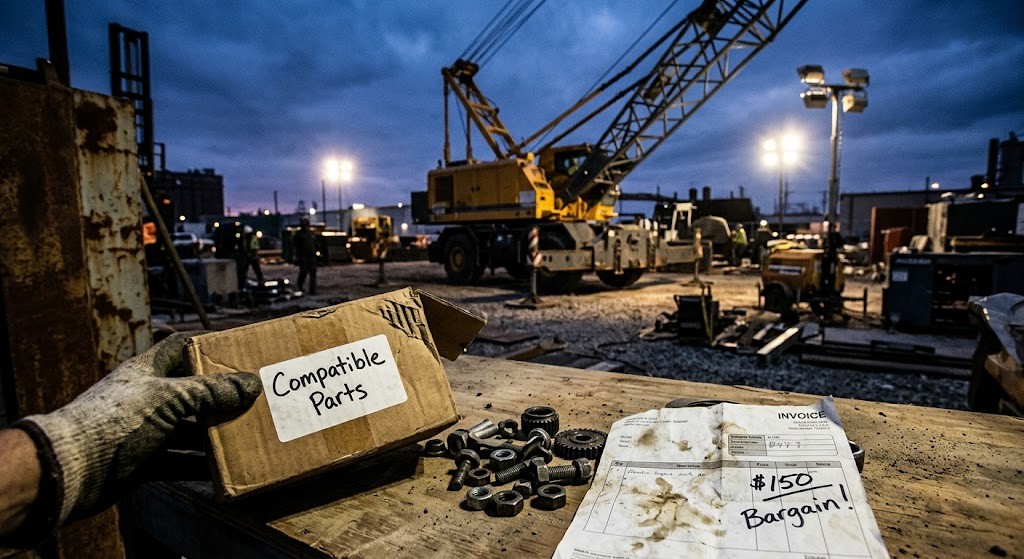
An enticing offer pops up on your procurement screen. A vendor confidently promotes Kobelco crane parts at prices that make authorized distributors seem almost extortionate. The math appears flawless—why pay premium rates when you can secure what looks like the exact same component for a fraction of the cost? But numbers on a screen don’t tell the whole story, and what you can’t see may ultimately bankrupt your operation.
Inexpensive, unauthenticated parts might soothe your immediate budget concerns, but they rarely soothe your operational anxieties. More often than not, they generate a snowball of expenses that transforms that initial “bargain” into a financial nightmare. If you’ve ever been seduced by a deal on Kobelco crane parts that seemed too advantageous to resist, prepare for a thorough examination of what you’re really risking.
The Psychology Behind Cost-Cutting Procurement
Let’s be frank about industry realities. Construction margins are razor-thin. Every minute a crane remains idle bleeds profitability through standing labour, extended project timelines, and potential penalty clauses. The urgent imperative to restore equipment often overwhelms methodical purchasing practices. Alternative parts suppliers capitalize on this vulnerability, advertising their wares as expedient, budget-friendly fixes through countless online channels, independent stockists, and occasionally even mainstream industrial outlets that market them as “practical alternatives.”
Yet fitting a component into a mounting bracket is a world away from matching its engineered performance characteristics. A part might connect seamlessly to your hydraulic lines and electrical harnesses, but that reveals nothing about its material grain structure, its resistance to thermal cycling, or its capacity to endure millions of stress reversals. In crane operations, average performance is never acceptable—you demand exceptional durability under the most grueling duty cycles.
The Costly Consequences That Emerge Over Time
1. Premature Breakdowns Trigger Endless Repair Cycles
Unauthorized parts are produced without access to original engineering data, proprietary alloy recipes, or stringent factory quality regimes. They frequently compromise with recycled materials, sloppy machining tolerances, and omitted non-destructive testing. The result? Components that degrade rapidly, develop surface cracks, or experience sudden catastrophic failure precisely when demand peaks.
Each unplanned stoppage carries substantial costs—lost productivity, expedited shipping charges for emergency replacements, overtime payments for maintenance crews, and possible compensation claims from delayed clients. A discount part that barely achieves half its expected service interval isn’t a saving; it’s a repeating financial drain. And if that failure manifests during a heavy lift, you’re confronting not just a simple parts swap but possible damage to structural elements that could sideline your crane for weeks.
2. Catastrophic Safety Failures You Must Face
Cranes rank among the most dangerous equipment on any construction or industrial site. They routinely manipulate enormous masses, often suspended over workers, adjacent buildings, and critical infrastructure. A non-certified component incapable of managing operational stresses isn’t merely an inconvenience—it’s a life-threatening hazard.
Envision a turntable bearing that locks during a swing manoeuvre, or a counterweight cylinder that loses pressure while holding a multi-ton load. The implications extend well beyond property damage—they involve serious bodily harm, potential fatalities, criminal negligence investigations, and lawsuits that can decimate even large enterprises. Kobelco genuine components incorporate safety margins, redundant features, and exhaustive validation under extreme load scenarios. Aftermarket suppliers offer no such guarantees—only optimistic marketing and disclaimers that absolve them of any liability.
3. Warranty Nullification and Astronomical Repair Expenditures
Every major crane manufacturer, including Kobelco, explicitly conditions warranty protection on the utilization of certified genuine components. The moment you install an unauthorized substitute, that coverage terminates immediately. When consequential damage follows—as it almost certainly will—you absorb every expense, from diagnostic assessments to complete system replacements that can exceed six-figure amounts.
Moreover, inferior parts frequently set off destructive chain reactions. An off-spec hydraulic pump might generate excessive vibration that damages mounting brackets and adjacent plumbing. A substandard electrical sensor could send erroneous data to the control module, causing erratic movements that stress the entire powertrain. The cumulative repair costs can dwarf your original “savings” by a factor of ten or more—a painful reminder that compromising on quality is never a sound business strategy.
4. Insidious Efficiency Losses That Erode Profitability
Cranes seldom operate in isolation; they integrate with material supply chains, workforce scheduling, and interdependent construction activities. When one crane lags, the entire orchestration frays. Hoist speeds diminish, swing accuracy degrades, and cycle times elongate—each inefficiency nibbling at your competitive edge. Project completion dates stretch, triggering extension penalties and damaging client trust.
Even when an aftermarket component restores basic functionality, it often introduces subtle but persistent losses. Rough internal surfaces increase friction and heat generation, raising fuel consumption across the fleet. Imprecise valve spools compromise hydraulic responsiveness, prompting operators to adopt slower, more conservative techniques. Across a full operational year, these incremental deficiencies aggregate into significant profit leakage—a hidden tax that never appeared on your initial quotation.
5. Diminished Resale Prospects That Punish Your Asset Strategy
When fleet modernization eventually arrives, the maintenance documentation for each crane serves as its valuation cornerstone. Trained appraisers and discerning purchasers meticulously review parts histories for OEM authenticity. A record cluttered with generic numbers signals questionable stewardship, unknown component provenance, and elevated susceptibility to hidden wear.
Cranes with impeccable genuine-parts credentials consistently achieve premium market valuations. Conversely, those with mixed maintenance profiles can suffer substantial depreciation—often shedding 20–30% of potential resale worth. Those inexpensive replacements you installed to conserve a few dollars could cost you many thousands when the time comes to sell or trade. This reality underscores why reputable organizations like HL Equipment advocate fiercely for maintaining OEM integrity from acquisition to disposition.
The HL Equipment Assurance
What represents the intelligent procurement alternative? Engaging a dependable authority like HL Equipment ensures every delivered component carries factory certification, complete traceability, and robust warranty protection. Authentic Kobelco crane parts are cast from identical material specifications, machined to identical geometric tolerances, and validated through identical testing protocols as the original installations—nothing is diluted or delegated to unvetted subcontractors.
HL Equipment provides substantially more than transactional parts supply. Their technical specialists understand the particular demands of every Kobelco model series, from compact urban cranes to massive lattice-boom excavators. They offer serial-number verification, replacement interval recommendations, and installation procedural support to eliminate uncertainty. No questionable sourcing. No speculative substitutions. Just dependable, durable solutions that safeguard your operational investment.
The Hard Reality: Discounted Items Invariably Prove Costlier
It’s instinctive to compare sticker prices. Yet the comprehensive cost of any component encompasses every downstream consequence—emergency stoppages, safety investigations, collateral mechanical damage, operational drag, and depreciated asset valuation. Each element exacts a financial penalty that massively exceeds any initial price reduction.
Non-genuine Kobelco crane parts might reduce your purchase order by a modest amount, but they’ll extract many times that figure over your equipment’s remaining useful life. In a sector where reliability directly influences profitability and where safety breaches can prove catastrophic, gambling on inferior components is a risk that no prudent manager should entertain.
Strengthening Your Procurement Position
If your inventory currently contains non-OEM parts, immediate remedial action is essential. Undertake a meticulous audit, flagging every unverified component against genuine Kobelco crane parts specifications. Develop a phased replacement plan, prioritizing safety-critical systems including hoist mechanisms, slew drives, and hydraulic control circuits. Collaborate with a supplier of unimpeachable reputation—an organization like HL Equipment that has built its business on delivering only authentic, fully warranted components that you can trust implicitly.
Always maintain this fundamental perspective: the lowest quoted price almost never translates to the lowest total cost of ownership. The wisest procurement decision is the one that ensures your crane continues operating at its design capacity, with uncompromised safety standards, throughout its intended service lifetime. Genuine parts aren’t simply a procurement category—they’re the bedrock of your operational continuity, your professional reputation, and your long-term financial health.