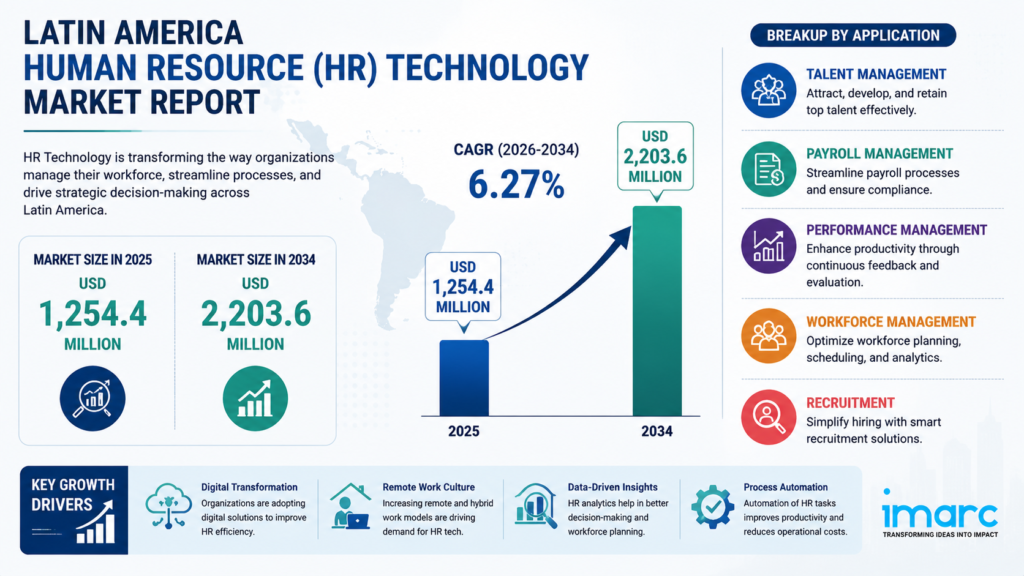
This is just the baseline of a long-term modernization trend. Looking ahead, the market is projected to reach an impressive USD 2,203.6 Million by 2034. This trajectory represents a steady Compound Annual Growth Rate (CAGR) of 6.27% during the forecast period of 2026–2034.
According to the comprehensive insights from the Latin America Human Resource (HR) Technology Market report by IMARC Group, the regional market reached a substantial valuation of USD 1,254.4 Million in 2025.
Key Market Growth Drivers
The forward momentum of the Latin American HR tech ecosystem is propelled by powerful macro-environmental changes, shifting labor regulations, and innovative advancements in artificial intelligence.
- Evolving Workforce Dynamics and the Tech-Savvy Shift
Latin America is experiencing major changes in its baseline workforce demographics. Rapid urbanization has concentrated top-tier talent into major metropolitan hubs, forcing companies to adopt advanced recruitment and retention tech to stay competitive.
At the same time, a younger, digitally native workforce is entering the labor market. These employees expect intuitive, mobile-first tools that mirror the consumer apps they use daily. Furthermore, the booming gig economy and flexible hybrid working arrangements have created an intense need for digital solutions that facilitate remote collaboration, project-based resource allocation, and continuous employee engagement.
- The Universal Digital Transformation Imperative
As businesses across the region wake up to the transformative power of corporate digitalization, HR departments are being thrust into the spotlight. The urgent need to eliminate manual errors, lower administrative overhead, and boost overall operational efficiency is driving widespread adoption.
The disruption caused by the COVID-19 pandemic highlighted the inherent risks of offline, fragmented personnel files. Today’s market demands agile, remote-friendly systems that allow leaders to access workforce analytics and manage organizational structures from anywhere in the world.
- A Rapid Shift Toward Cloud-Enabled HR Systems
Forward-thinking enterprises are rapidly executing a cloud-first strategy, ditching static on-premises installations in favor of secure, centralized cloud HR systems. These cloud-enabled platforms make it incredibly simple to unify payroll management, recruitment tracks, and employee databases across multiple borders. As organizations scale regionally, cloud software ensures they can adapt flexibly to changing business needs while drastically lowering upfront infrastructure costs.
Key Market Segmentation: Mapping the Technology Ecosystem
To maximize the ROI of enterprise software deployments or identify high-growth investment avenues, stakeholders must understand how the Latin American HR tech marketplace breaks down across specific applications, delivery types, industry verticals, and company scales.
By Application
The market spans a comprehensive suite of digital tools designed to support the modern employee journey:
- Talent Management: Holding the majority of the market share due to the extreme complexity of sourcing, assessing, and nurturing specialized skills in a competitive job market. AI-driven analytics help companies predict hiring trends and design targeted upskilling tracks.
- Payroll Management: A critical application driven by the need for localized tax compliance, automated direct deposits, and error-free wage tracking.
- Performance Management: Transitioning from annual reviews to continuous feedback systems powered by real-time goal tracking.
- Workforce Management: Providing essential scheduling, time-tracking, and shifts-management tools for remote and on-site staff.
- Recruitment: Streamlining candidate pipelines through applicant tracking systems (ATS) and algorithmic matching.
- Others: Including employee benefits administration, wellness portals, and internal communication networks.
Sample Request For Your Business
By Type
Organizations choose their operational models based on their internal tech capabilities and scaling goals:
- Outsourced: Representing the largest market segment across the region. Companies are aggressively leveraging external HR tech providers to access premium applicant tracking and performance tools without the financial burden of building and maintaining custom in-house architectures.
- Inhouse: Selected primarily by legacy enterprises seeking highly customized, proprietary system setups.
By End Use Industry
Digital personnel tools are being adopted across every core sector of the Latin American economy:
- Information Technology (IT): Accounting for the largest market share. The highly dynamic nature of the IT sector requires exceptionally agile systems to manage diverse tech talent, track fluid skill sets, and maintain seamless collaboration across distributed virtual teams.
- BFSI (Banking, Financial Services, and Insurance): Relying heavily on secure data structures to manage massive compliance and regulatory training frameworks.
- Health Care: Utilizing automated shift scheduling and credential tracking for frontline medical staff.
- Public Sector: Modernizing administrative systems to increase public workforce transparency.
- Travel, Transportation, and Hospitality (TTH): Managing high-volume, seasonal, and shift-based employee pools.
- Others: Including retail, manufacturing, and education sectors.
By Company Size
The demand for scalable personnel platforms is heavily influenced by organizational headcount:
- Greater than 5k Employees: Representing the largest market segment. Managing massive workforces manually is highly prone to error; these enterprises utilize enterprise-grade automation and self-service employee portals to streamline large-scale operations.
- 1k – 5k Employees: Mid-market organizations utilizing cloud platforms to support aggressive regional expansions.
- Less than 1k Employees: Growing businesses leveraging cost-effective software-as-a-service (SaaS) tools to formalize their HR structures.
Breakup by Country: The Regional Leaders
The geographic distribution of the Latin American HR technology footprint highlights distinct hubs of digital maturity:
- Brazil: The undisputed heavyweight of the regional market, holding the largest market share. Driven by a massive, diverse workforce and a strong national commitment to corporate digitalization, Brazilian firms are rapidly implementing cloud architectures and AI analytics to bridge geographic barriers.
- Mexico: A massive growth hub experiencing heavy corporate investments, fueled by strong public policy pushes for workplace digitalization and cross-border business expansions.
- Argentina: A mature marketplace acting as a major creative and digital talent hub, seeing high demand for advanced talent management and remote work software.
- Colombia, Chile, and Peru: Rapidly emerging tech economies witnessing widespread corporate modernization, falling cloud deployment costs, and high corporate openness to automated human resource solutions.
Competitive Landscape: Strategic Movements
The competitive architecture of the Latin American market features a dynamic mix of global enterprise software giants, specialized cloud-first providers, and agile regional startups. Dominant industry players are continuously integrating machine learning, natural language processing, and advanced workforce analytics into their platforms to secure a competitive edge and deliver frictionless user experiences.
Recent News in the Market: Strategic Consolidation and Expansion
The ecosystem is moving at a blistering pace, characterized by high-profile corporate acquisitions and community-driven skill-building initiatives designed to support regional talent development:
AI-Driven Market Consolidation
In April 2025, prominent software leader Visma successfully acquired Lara AI, an innovative Argentina-based HR tech company. This major transaction significantly strengthens Visma’s operational presence in the Latin American human resource software landscape. Lara AI’s advanced platform leverages artificial intelligence to seamlessly automate routine HR tasks and heavily boost employee engagement, allowing corporate HR teams to step away from administrative paperwork and focus entirely on long-term culture and talent development.
Empowering Regional Workforce Infrastructures
In January 2025, HR tech giant UKG partnered with Dell Technologies to officially open a Solar Community Hub in Los Pinos Park, Mexico. Backed strategically by Computer Aid International and Tecnológico de Monterrey, this advanced hub is designed to directly support 20,000 residents across the Campana and Altamira areas by providing critical digital access, technology education, and workforce training. This impactful initiative reinforces UKG’s long-term commitment to the Latin American ecosystem by empowering local communities with the core digital skills required to fuel Mexico’s booming economic growth.
About Us
IMARC Group engages with the world’s most ambitious changemakers to make a lasting impact․ It provides thorough market entry strategies and solutions for its clients․ IMARC provides such services as business research and forecasts‚ feasibility studies‚ business registries and formations‚ establishing factories‚ government and regulatory clearances and licenses‚ branding‚ marketing and sales consulting‚ competitor research and benchmarking‚ and price‚ cost and procurement research․
Contact Us
IMARC Group‚
134 N 4th St‚ Brooklyn‚ NY 11249‚ US
Email: sales@imarcgroup․com
Tel No: (D) +91 120 433 0800
United States: +1-201971-6302