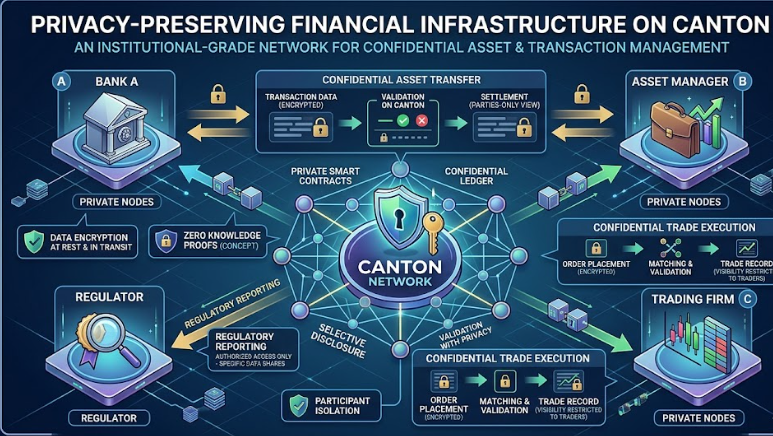
Privacy-Preserving Financial Infrastructure on Canton
Introduction to Privacy-First Finance
Financial systems are entering a new era where transparency and privacy must coexist. Traditional banking infrastructure was never designed for real-time global connectivity, yet today’s financial world demands exactly that. At the same time, sensitive financial data cannot be exposed across networks without strict control. This tension has led to the emergence of privacy-preserving financial infrastructure built on advanced blockchain systems like Canton.
Privacy in finance is not just about secrecy; it is about control. Institutions need the ability to share only what is necessary while keeping the rest hidden. This selective visibility is becoming a cornerstone of modern digital finance. As global markets become increasingly interconnected, privacy-preserving systems ensure that collaboration does not come at the cost of confidentiality.
The rise of institutional blockchain adoption has further accelerated this shift. Enterprises are no longer experimenting with blockchain; they are deploying it in production environments for settlements, asset management, and interbank coordination. Canton Network plays a central role in this transformation by offering a framework designed specifically for regulated financial ecosystems.
Understanding Canton Network
What is Canton Network
Canton Network is a decentralized infrastructure designed to support privacy-first financial applications across multiple institutions. Unlike traditional blockchains that replicate all data across all nodes, Canton introduces a fundamentally different model in which transactions are visible only to relevant parties.
This design allows financial institutions to maintain confidentiality while still participating in a shared ecosystem. It is particularly suited for regulated industries where compliance and data protection are non-negotiable.
Core Architecture and Design Principles
Canton operates on the principle of selective transparency. Instead of broadcasting all transaction data globally, it enables granular data sharing between participating entities. This ensures that each party only sees what it is authorized to see.
Another key principle is modularity. Canton is not a single monolithic chain but a network of interconnected systems. Each application or institution can operate independently while still synchronizing with others when required.
Role of Interoperability and Privacy
Interoperability is critical in modern finance. Institutions often operate on different systems, databases, and compliance frameworks. Canton bridges these gaps by allowing secure communication without exposing sensitive information. Privacy is preserved at every layer, from transaction execution to settlement finality.
How Canton Enables Privacy-Preserving Infrastructure
Data Isolation and Selective Disclosure
One of the most powerful features of Canton is data isolation. Instead of replicating every transaction across the network, Canton ensures that only involved parties can access relevant data. This selective disclosure model reduces exposure risk and strengthens compliance.
Atomic Settlement Across Systems
Financial markets require certainty. Either a transaction completes fully, or it does not happen at all. Canton enables atomic settlement across multiple systems, ensuring that complex financial operations execute without partial failures.
Smart Contract Execution with Confidentiality
Smart contracts on Canton are designed to operate without revealing unnecessary data. This is a major advancement compared to traditional blockchain platforms where contract execution is fully transparent. Here, logic can be verified without exposing sensitive inputs.
Key Components of Financial Infrastructure on Canton
Identity and Permission Layers
Identity management is foundational in Canton’s architecture. Institutions must verify counterparties before engaging in transactions. Permission layers ensure that only authorized participants can access or execute financial operations.
Asset Tokenization Frameworks
Tokenization of real-world assets is a major use case. From bonds to real estate, Canton allows assets to be digitally represented while preserving ownership integrity and compliance requirements.
Cross-System Synchronization
Financial institutions rarely operate on a single system. Canton enables synchronization across multiple ledgers, databases, and financial platforms without requiring data duplication.
Compliance and Audit Readiness
Compliance is embedded directly into the infrastructure. Every transaction can be audited by authorized entities without exposing data publicly. This reduces regulatory friction while maintaining transparency where required.
Use Cases in Modern Finance
Capital Markets and Securities
Capital markets require fast, secure, and compliant systems. Canton enables real-time settlement of securities while preserving confidentiality between traders, brokers, and regulators.
Banking and Interbank Settlement
Interbank settlements often involve complex reconciliation processes. Canton simplifies this by enabling direct, privacy-preserving settlement between banks, reducing operational overhead.
Real-World Asset Tokenization
Tokenization allows physical assets to be represented digitally. This includes real estate, commodities, and financial instruments. Canton provides the infrastructure needed to manage these assets securely and efficiently.
Role of Financial Software Development
Modern financial ecosystems depend heavily on robust backend systems. Financial software development plays a crucial role in building secure, scalable, and compliant applications on Canton. Developers must design systems that align with both blockchain architecture and regulatory requirements.
This includes building APIs for transaction management, creating secure data layers, and ensuring seamless integration with institutional systems. Without strong software engineering practices, even the most advanced blockchain infrastructure cannot deliver real-world value.
Fintech Software Integration in the Canton Ecosystem
Integration is where innovation meets practicality. Fintech software integration within Canton ensures that existing banking systems, payment gateways, and trading platforms can seamlessly interact with blockchain infrastructure.
This reduces the need for complete system overhauls. Instead, institutions can gradually adopt Canton-based solutions while maintaining their legacy infrastructure. Middleware, APIs, and secure connectors make this transition smooth and efficient.
Payment Software Development and Settlement Systems
Modern payment systems require speed, security, and reliability. payment software development in Canton enables real-time settlement with built-in privacy controls.
Unlike traditional payment rails that rely on multiple intermediaries, Canton reduces friction by enabling direct settlement between parties. This improves transaction speed and reduces costs while maintaining regulatory compliance.
Challenges in Privacy-Preserving Financial Systems
Regulatory Complexity
Different jurisdictions have varying requirements for data sharing and financial reporting. Building a unified system that satisfies all regulators is a major challenge.
Integration with Legacy Systems
Most financial institutions still rely on legacy infrastructure. Integrating Canton with these systems requires careful engineering and gradual migration strategies.
Future of Canton-Based Financial Infrastructure
The future of financial infrastructure is moving toward hybrid systems that combine traditional finance with blockchain innovation. Canton is positioned as a key enabler of this transformation.
We are likely to see increased adoption in areas such as cross-border payments, decentralized capital markets, and institutional DeFi applications. As privacy becomes a competitive advantage, systems like Canton will play a central role in shaping financial ecosystems.
Conclusion
Privacy-preserving financial infrastructure is no longer a theoretical concept; it is becoming a practical necessity. Canton provides a powerful foundation for building secure, compliant, and scalable financial systems that meet the demands of modern institutions.
By enabling selective disclosure, atomic settlement, and seamless interoperability, Canton is redefining how financial data is shared and processed. As adoption grows, it will likely become a cornerstone of next-generation financial architecture.